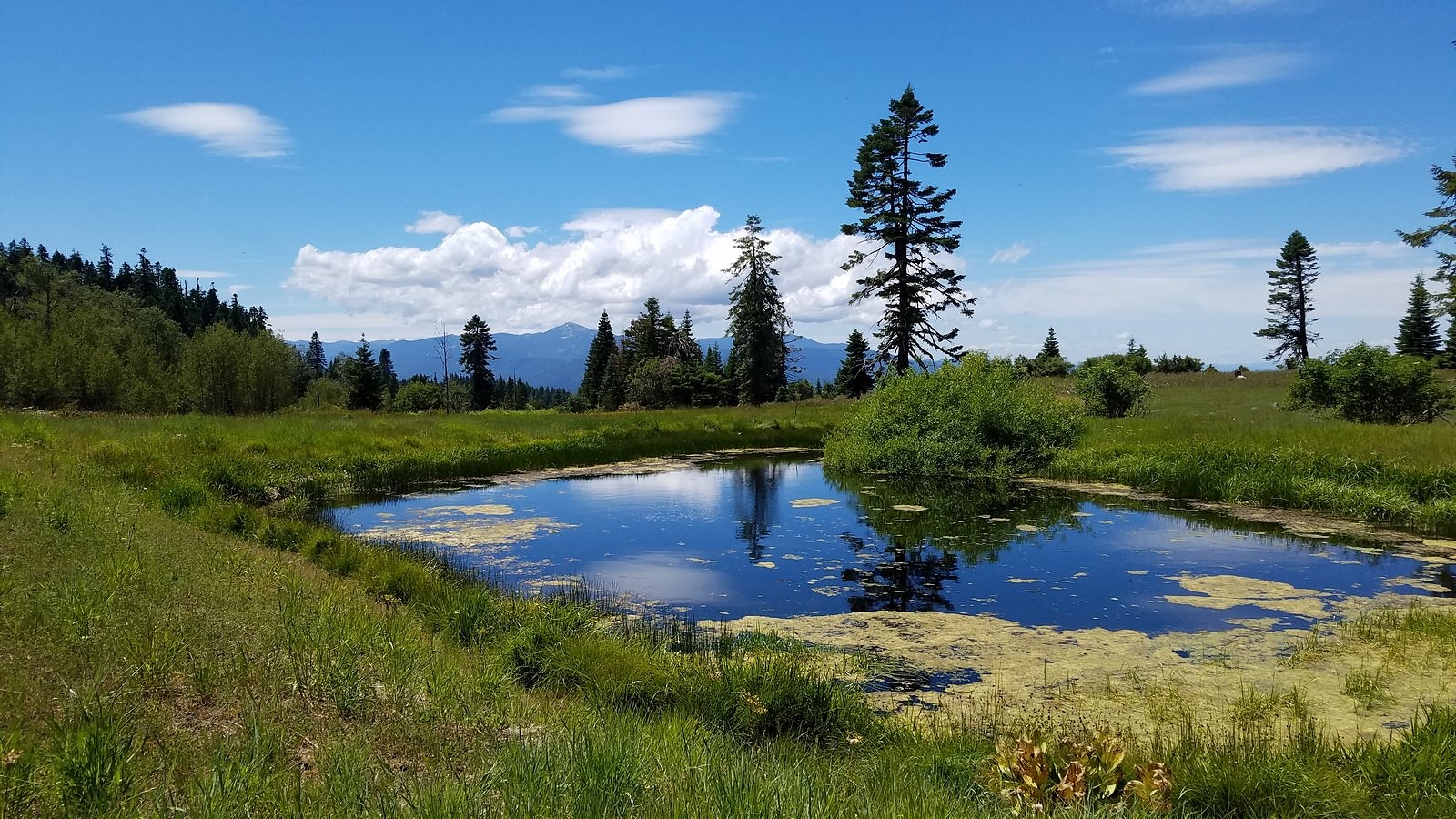
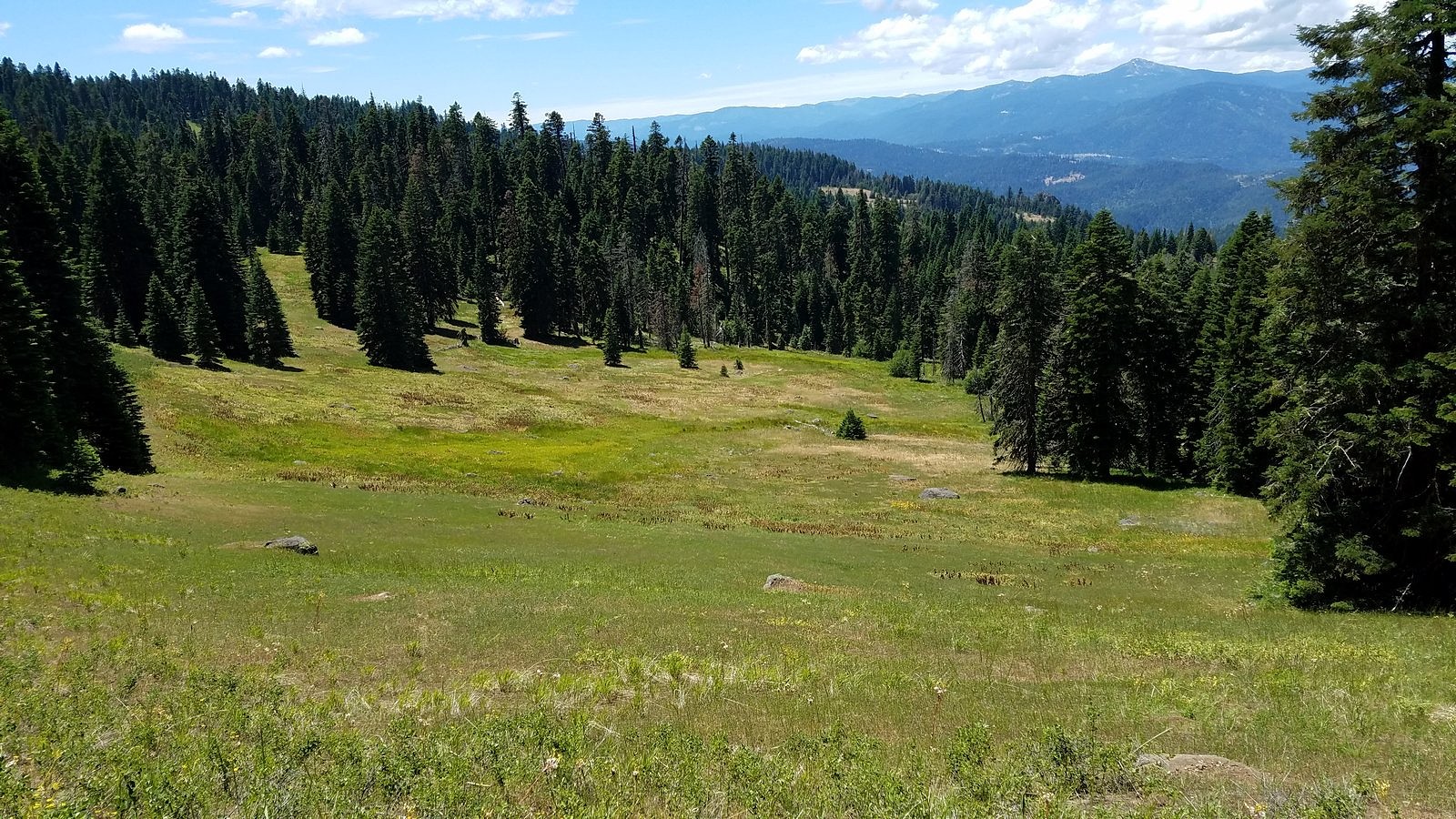
I promised a post on the hike I didn’t get around to blogging before we left town for a week, so here it is. It was a relatively short, relatively level walk on a stretch of the Pacific Crest Trail that traverses the northeastern slope of Soda Mountain near Ashland, Oregon. This section of the PCT is not known for its scenery – through-hikers usually just trudge through without stopping – but its mix of meadow and forest, with occasional views out to Ashland and the rest of the distant Bear Creek Valley, has a quiet charm about it. Streamlets abound in the meadows in early summer, and the mid-season flower displays can be spectacular, especially on one particular rocky knoll about a third of a mile in. It’s a great introduction to hiking in the the Cascade-Siskiyou National Monument for first-time visitors, and a relaxing afternoon stroll for old-timers like us who had just recently made the much stiffer climb up Grayback Mountain.
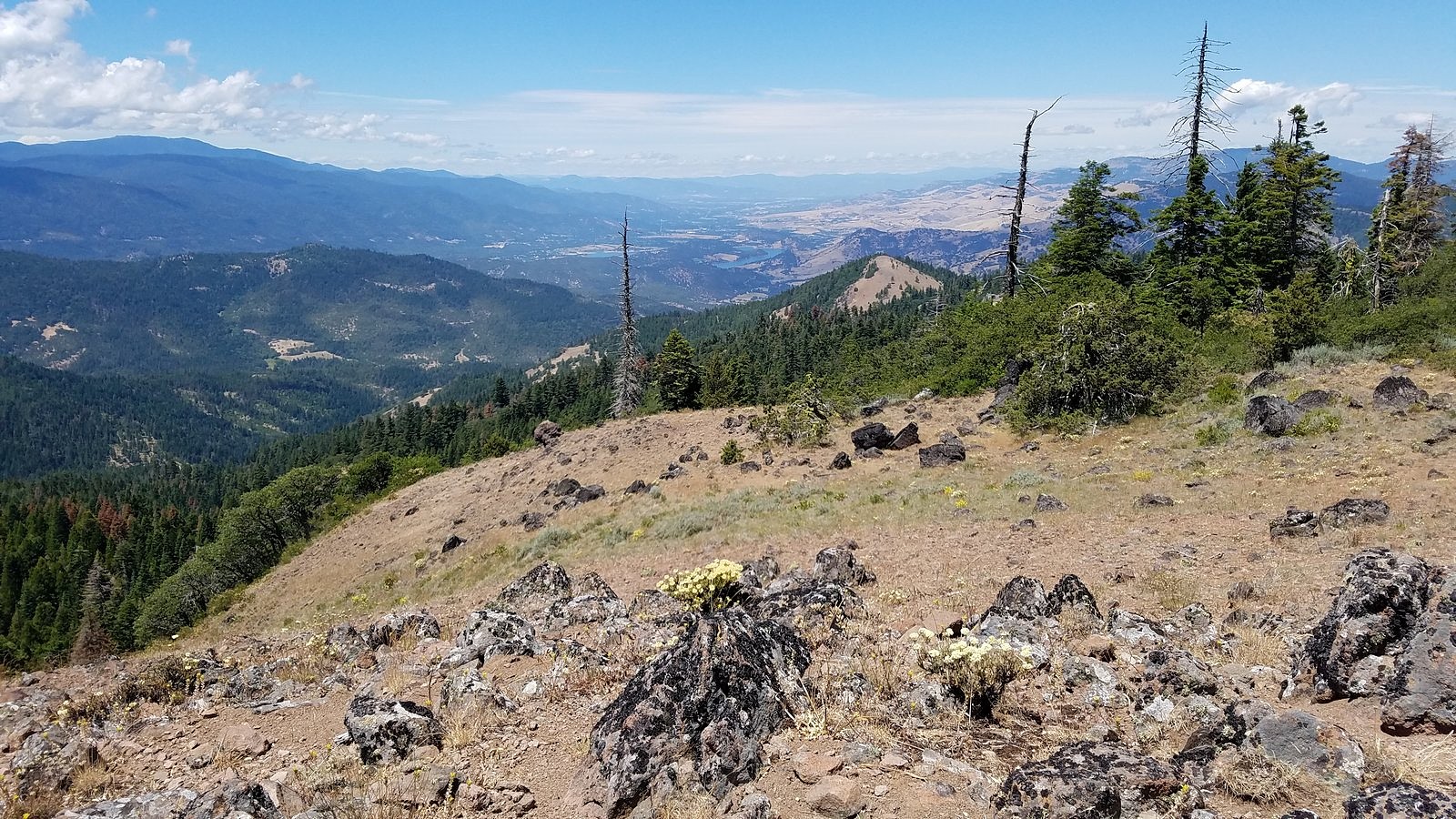
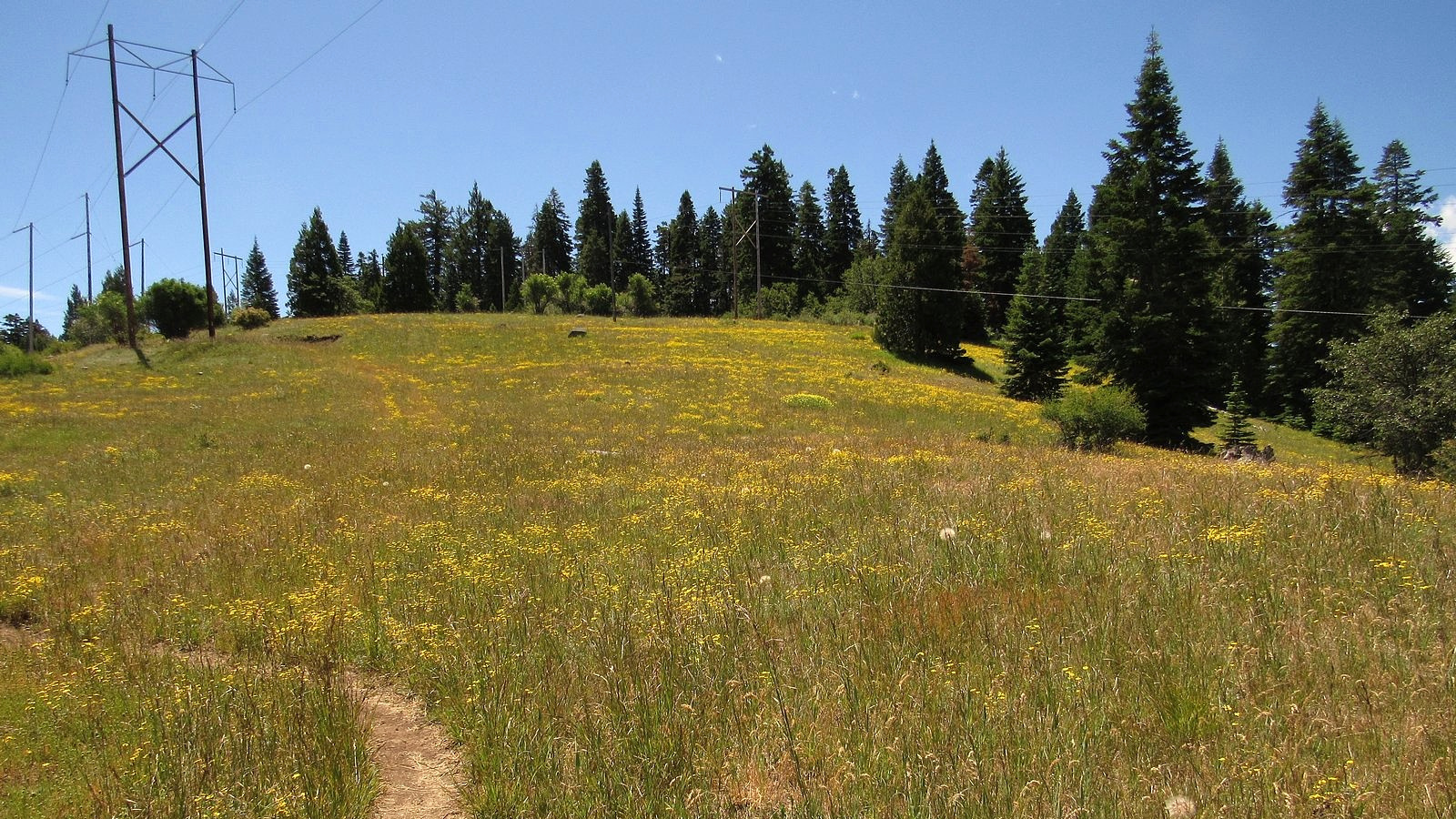
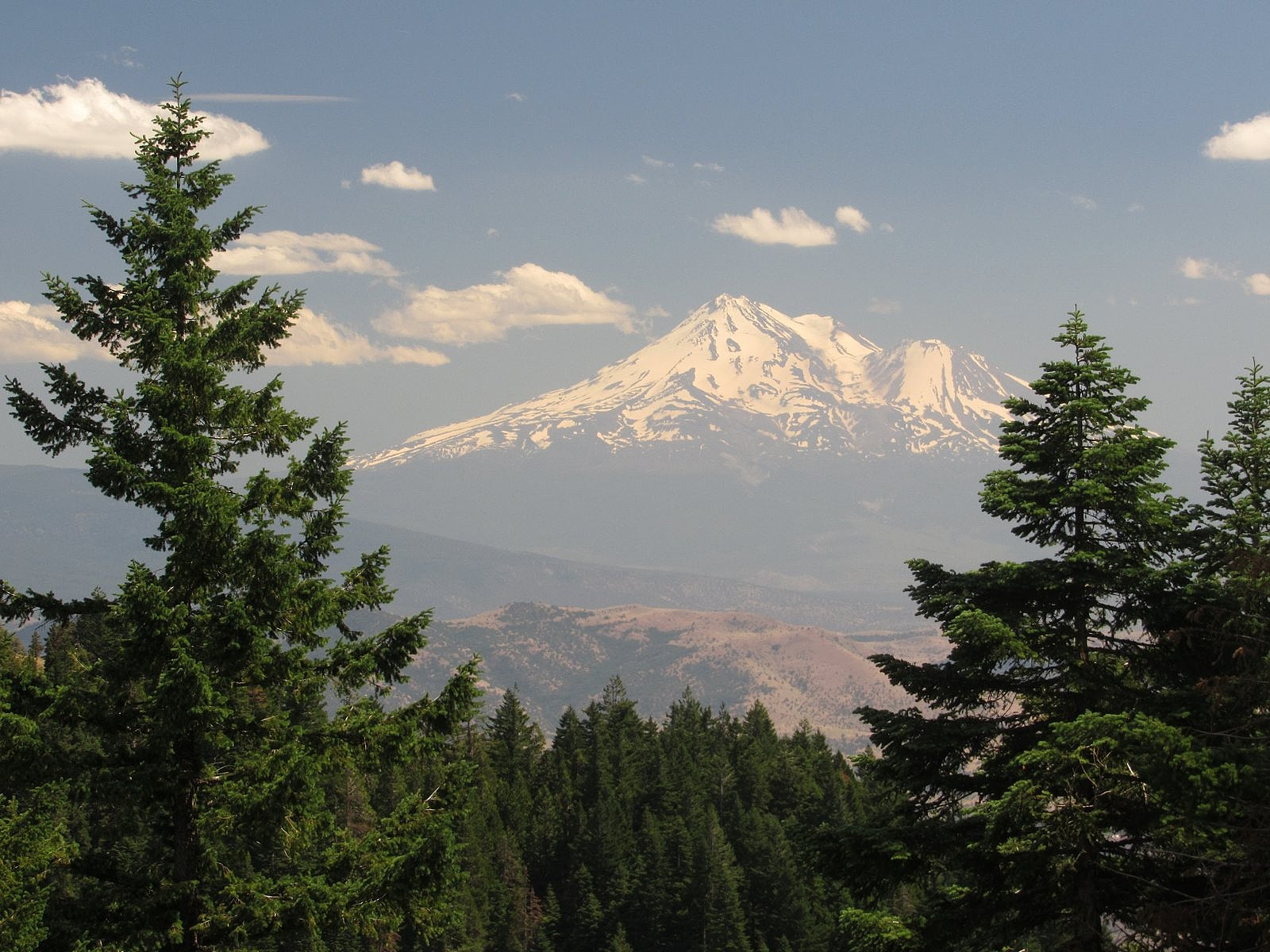
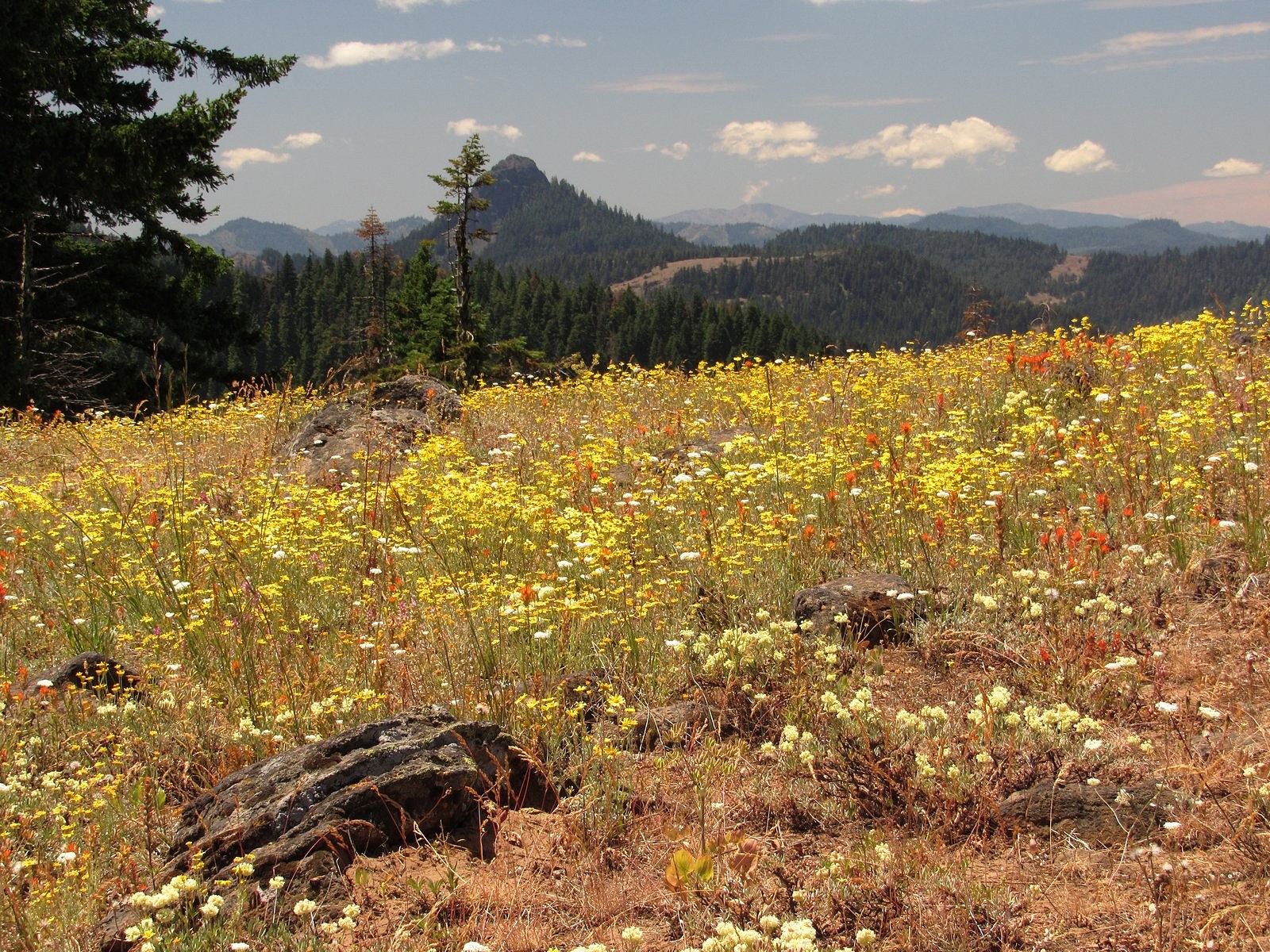
We parked the Bolt around 1:00 PM at the Hobart Bluff trailhead on the Soda Mountain Road, off Oregon Highway 66 at the Greensprings Summit, and headed south. The trailhead meadow was a yellow carpet of woolly sunflower under power lines; the knoll was spectacular, with woolly sunflower, paintbrush, buckwheat, and many other flowers covering nearly every square inch of ground beneath big views down the valley. After that, the flower displays were quieter but still lovely: hyacinths, columbine, honeysuckles, and many other plants in the woods; yampah and owls clover in the dry meadows; monkeyflowers and heals-all near the one small pond the trail passes in this stretch. We turned around at the saddle under Little Pilot Peak, a little less than three miles in, where there is a nice view south to Mt Shasta.
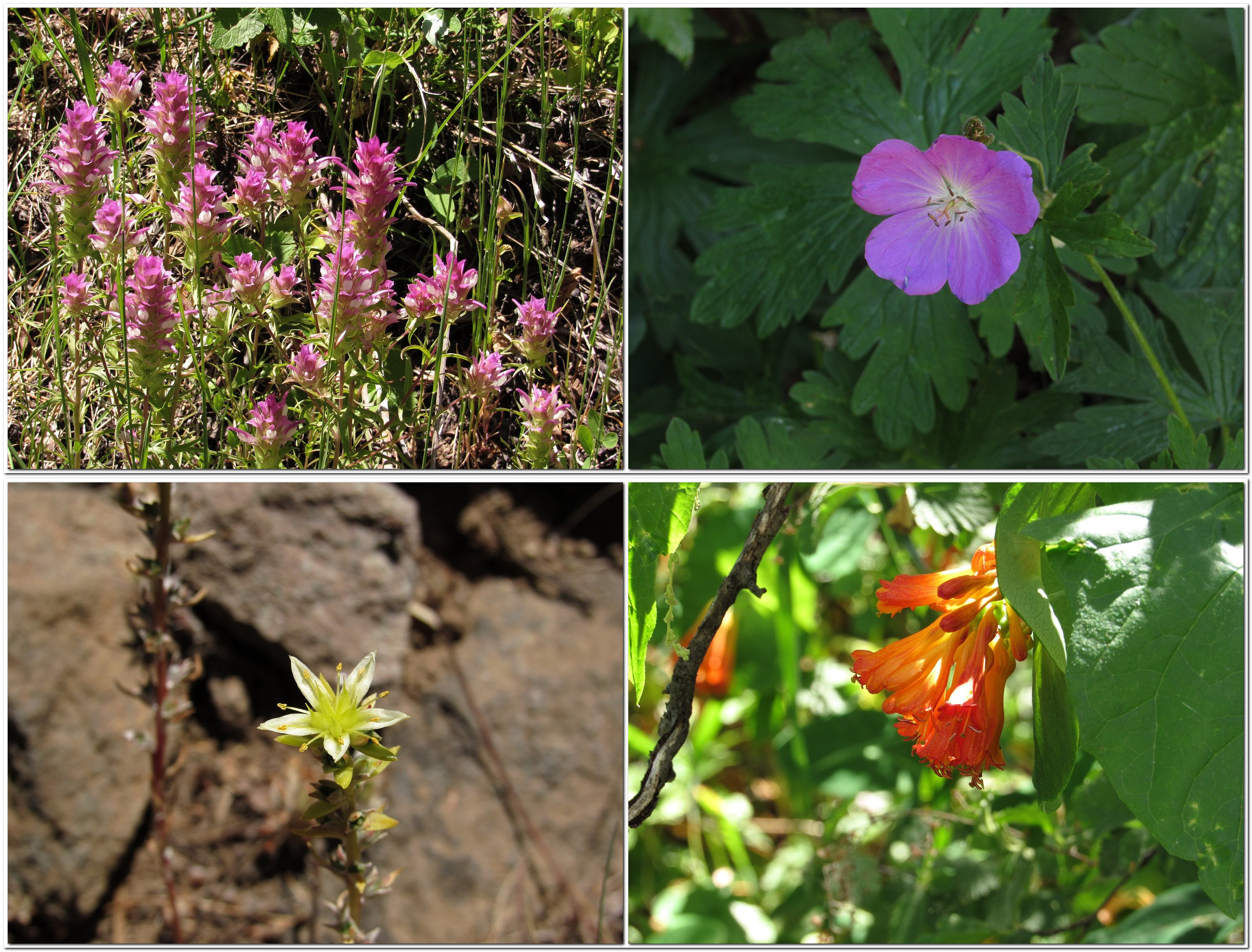
Clockwise from upper left: owl’s clover, Oregon geranium, honeysuckle, stonecrop.
It was 5:00 when we reached the car, so we headed for the Greensprings Inn, a small, old mountain restaurant and lodge a few miles east of the Greensprings Summit that has long been known among locals for the quality of its food. There is not much more to say. Enjoy the pictures.
Pilot Rock from the knoll. The predominant flowers are woolly sunflower, paintbrush, and buckwheat.
If I had to describe the O’Brien Creek trail in one word, it would be “brutal”. The trail, built long ago to supply a herders’ cabin in a large subalpine meadow in the Siskiyou Mountains, heads uphill abruptly from the trailhead and climbs 2000 thigh-challenging feet in two miles, all of it through dense, dark, mostly dry conifer forest. Not my normal idea of a good time. But it is also the best way to reach Grayback Mountain, and Grayback is definitely worth reaching. Grayback is the highest peak in Oregon’s Josephine County, and one of only a few Siskiyou summits to top 7,000 feet. The meadow spoken of a few minutes ago, Grayback Meadow, spreads up the bottom of a shallow bowl on the mountain’s steep east slope for nearly 1000 vertical feet – acres and acres of grass and little springs and wildflowers, edged by trees and capped by a lovely line of granite cliffs below the summit ridge. And from the summit, it is said, on a clear day you can see the ocean.
All of which is why Melody and I found ourselves in the Bolt last Friday morning, creeping up a road specified for high-clearance 4wd vehicles only, headed for the O’Brien Creek trailhead and that damned mountainside fall-line of a trail.
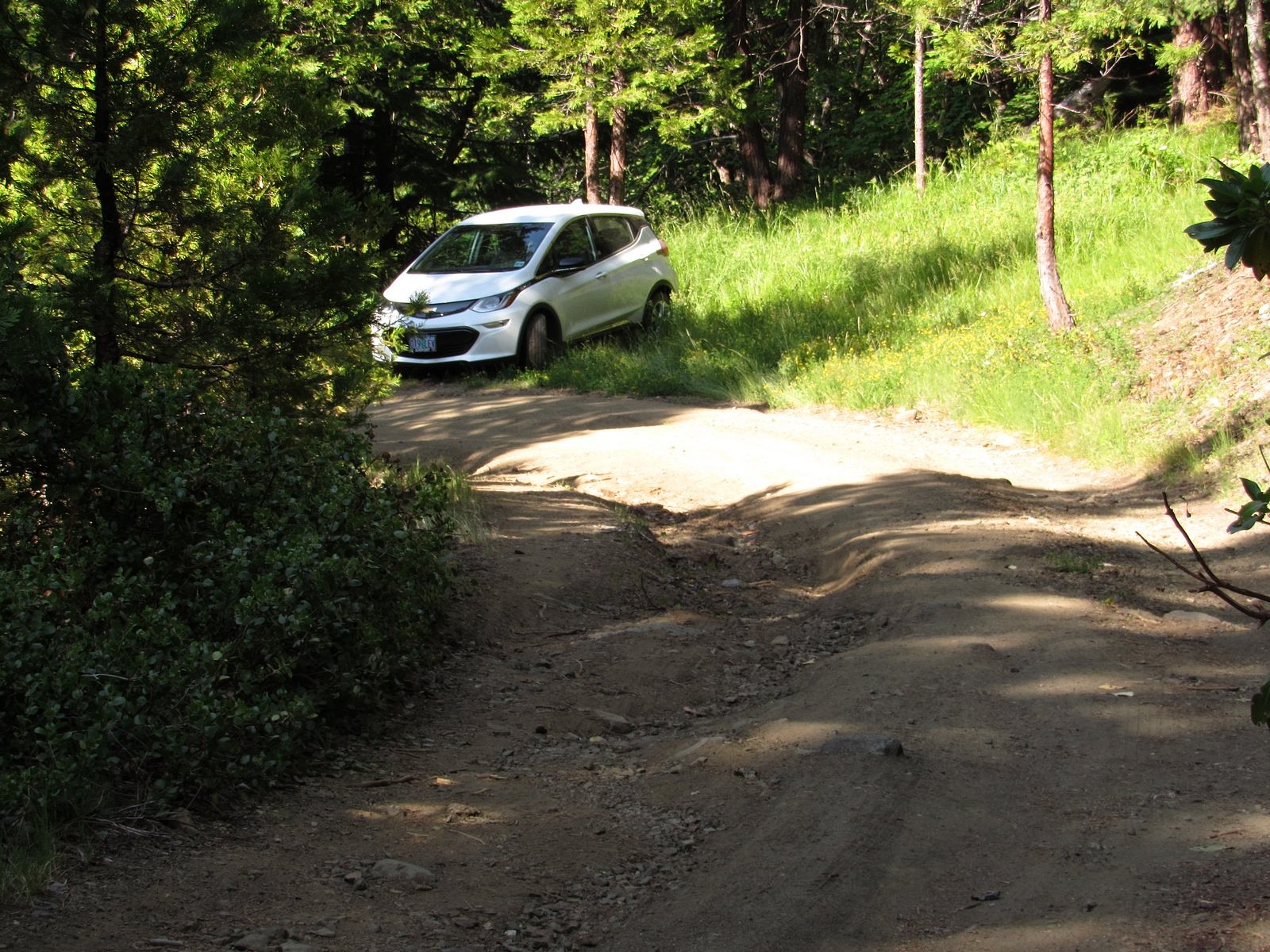
We didn’t quite get there – not in the car, anyway. Roughly half a mile before the road’s end, a fallen madrone had sprawled into the roadway. There was space to go around, but that space was occupied by a deep, rocky pothole followed immediately by a large rock. I had managed to work my way around all potholes and rocks until then, but I’d had the full width of the road to maneuver. This one looked impossible. So I backed the Bolt into a convenient flat area on a switchback 100 feet or so back down the road, locked it up, and we began walking. In fifteen minutes, we were on the trail.
The way up that steep, essentially switch-back-less two miles seemed very long. But there were woodland flowers to contemplate (wildflower photography is a great excuse to take rest stops), and there was a small side stream with a lovely little waterfall on it to cross, and eventually we broke out into the little clearing where O’Brien Creek itself tumbles across the trail. At that point the worst was over. It’s a half-mile from the creek crossing on a nearly level trail, past a small snow-survey cabin, to the site where the old Krause herders’ cabin stood at the foot of Grayback Meadow. The cabin burned down over a decade ago, but its stove is still there. So is its view.
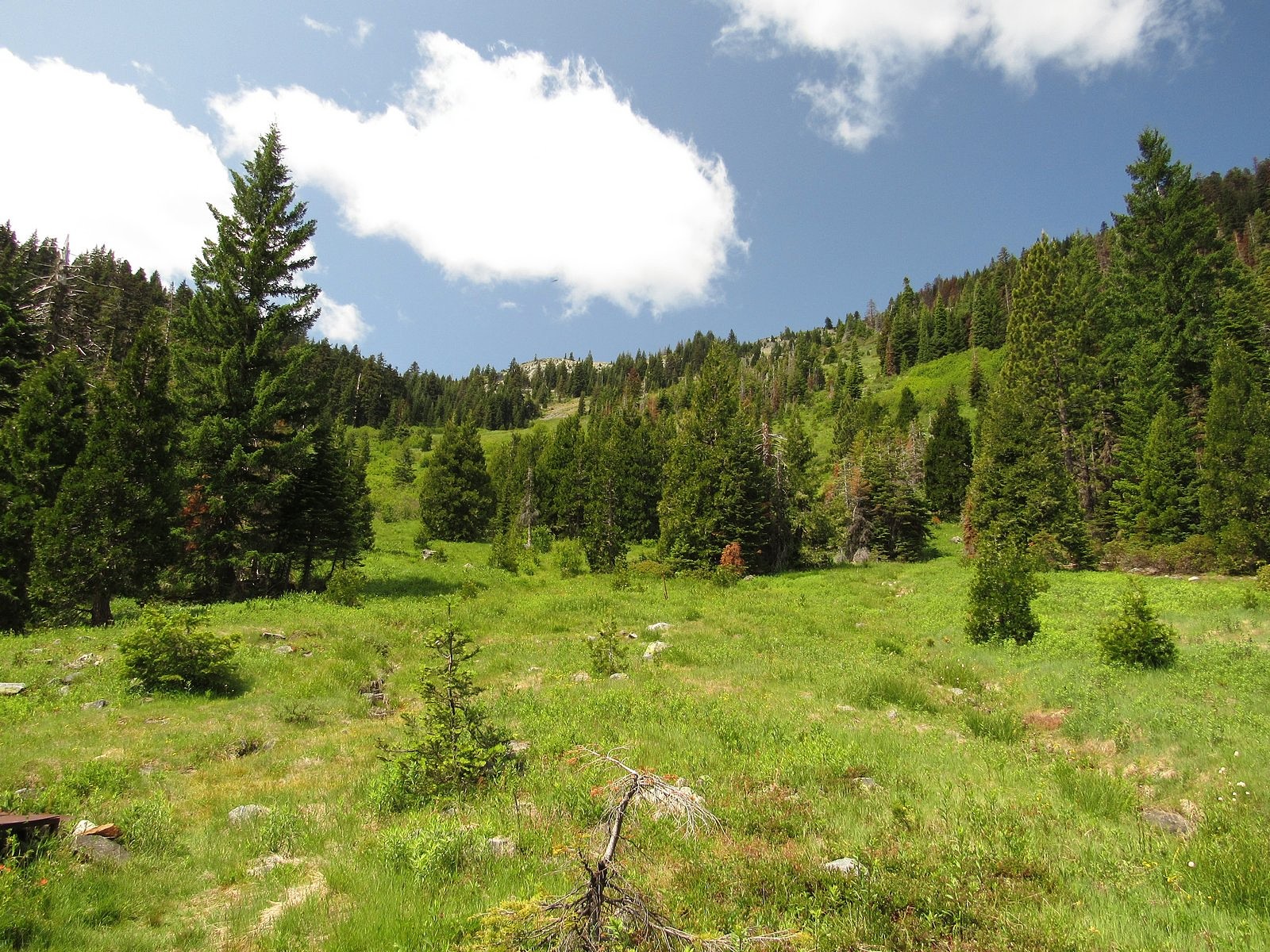
Grayback Meadow.
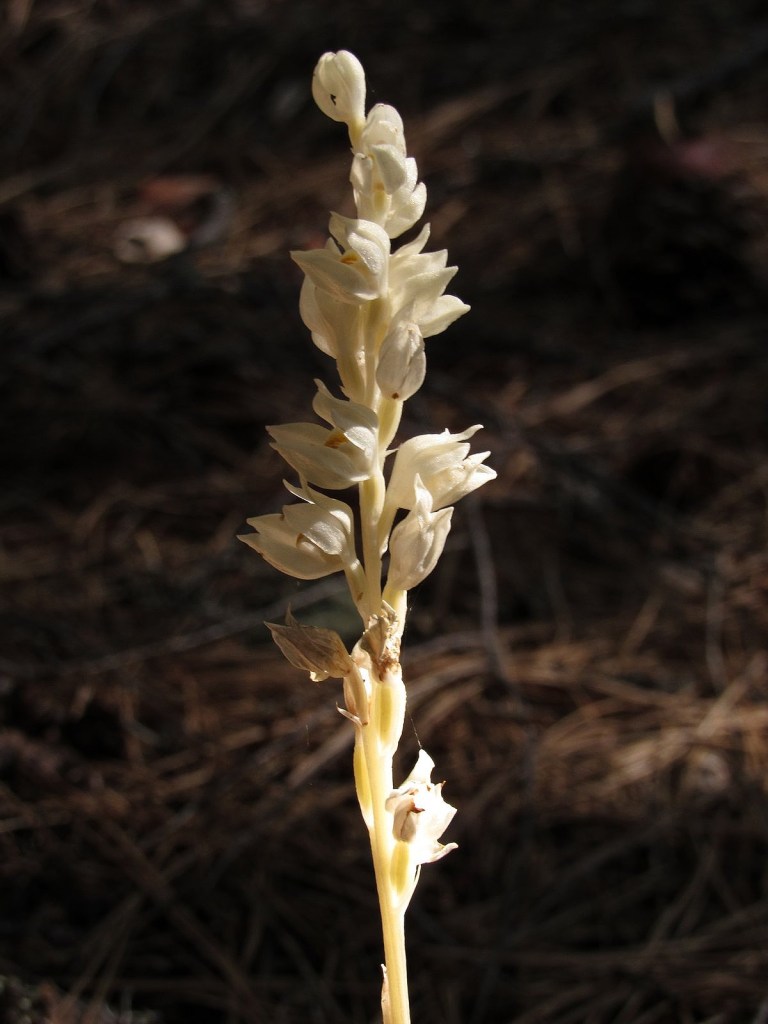
White rushlily, Hastingsia alba. Not in the guidebooks.
We moved slowly up the meadow, savoring. The slope was even steeper than the trail had been, but here there was sunshine, and the cliff far above us (but growing nearer), and views out that grew longer and vaster as we climbed. And nearly every square inch under our feet was covered with flowers. The Siskiyou Mountains are part of the larger Klamath Mountain system, which is mostly made of ultramafic rock – peridotite, serpentine, and their relatives – and ultramafic soils grow unusual plants. Grayback is actually made of granite, but it has its share. One flower, in fact – prolific here – is rare enough that it doesn’t appear in either of the standard wildflower guidebooks I use (see the accompanying photo). Others are Klamath Mountains endemics that would probably be happier on serpentine, but will also grow on granite. Add to those the standard mountain-meadow flowers you find everywhere in the west, and you begin to get the idea.
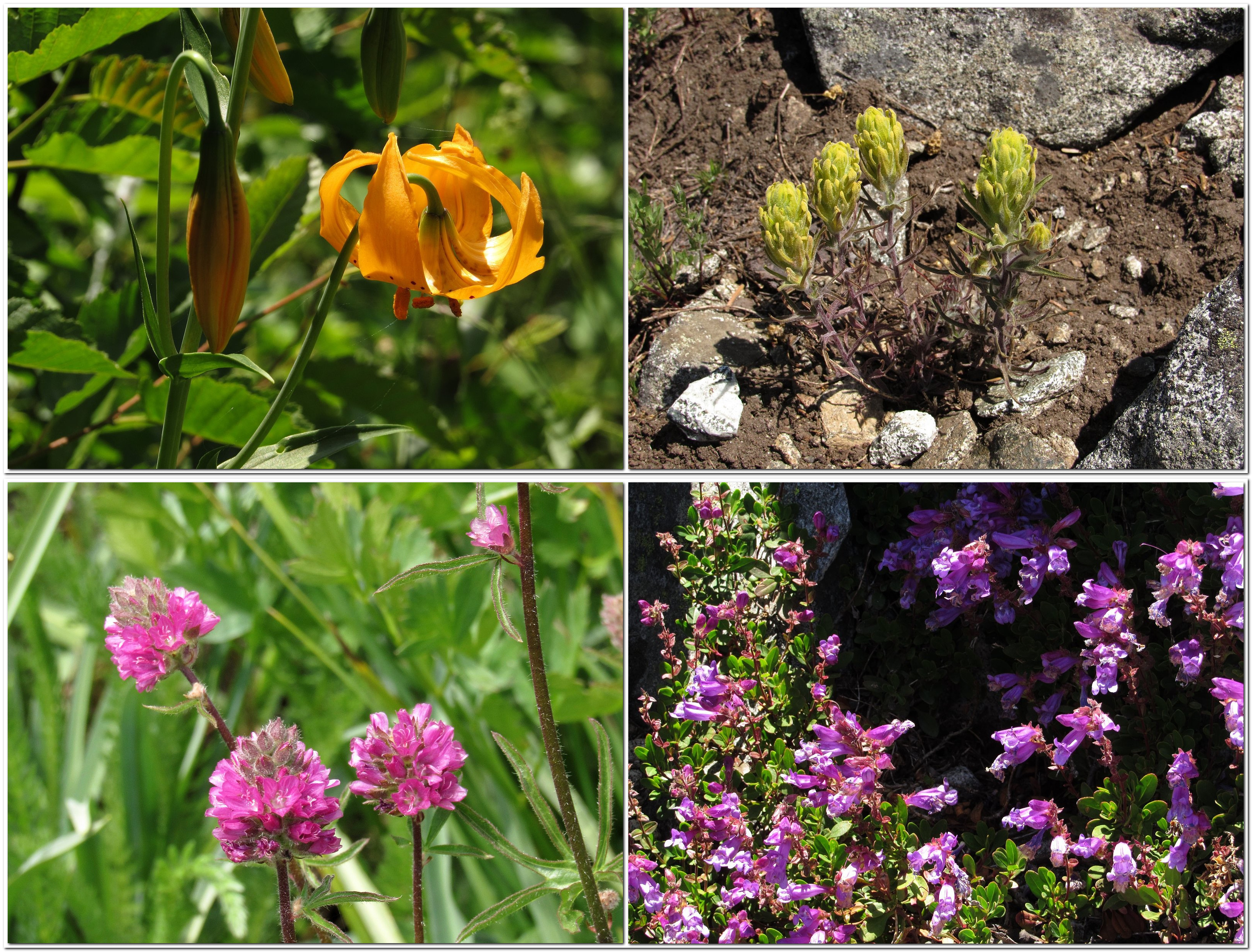
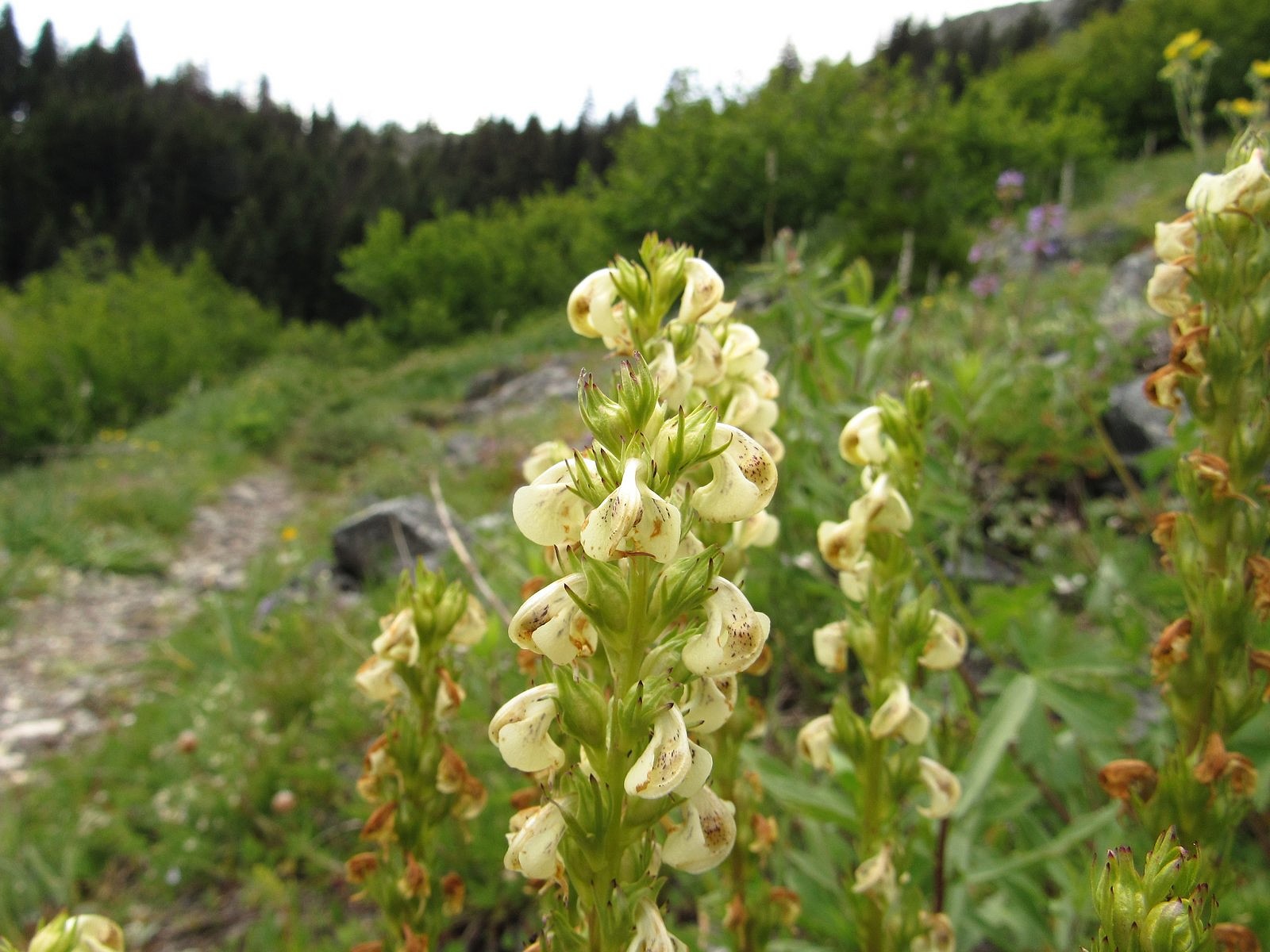
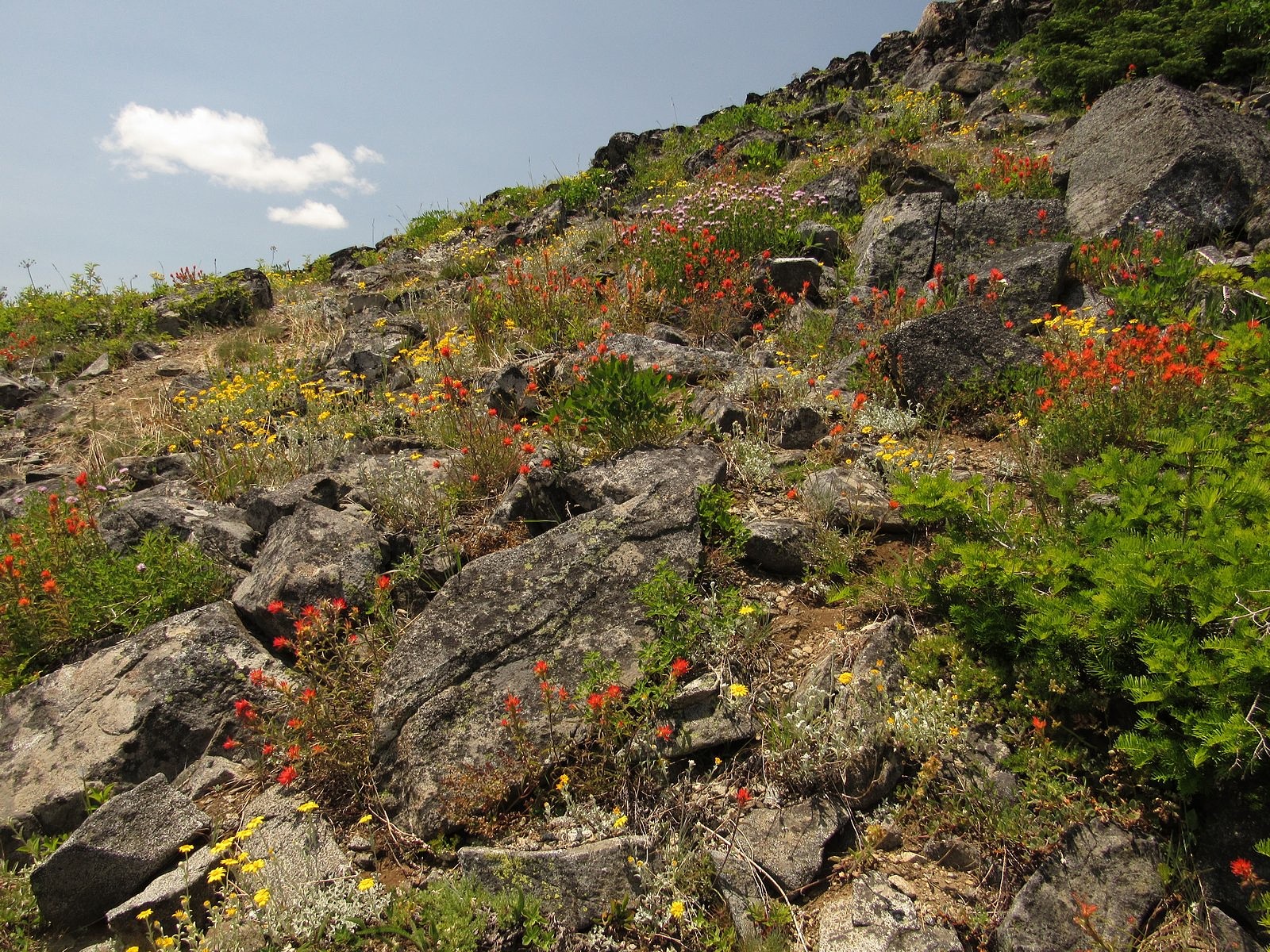
Clockwise from upper left: tiger lily, cobwebby paintbrush, Davidson’s penstemon, Oregon checker mallow.Coiled lousewort along the Boundary Trail.Paintbrush and woolly sunflower on the summit ridge.
An hour later and two-thirds of the way up the meadow we hit the Boundary Trail, so named because it runs along the western and southern boundaries of the Rogue River National Forest, beginning at Windy Gap – a little over a mile north of where we hit it – and ending many miles away at Lily Pad Lake, near the eastern end of the Red Buttes Wilderness. We took the Boundary Trail south for a mostly level half mile to the mountain’s south ridge, left it, and started boulder-hopping up the ridge. An hour of that, and we were on top. On top of the world.
I’m sorry to say that we couldn’t see the ocean. The air was too hazy to make it out, although the pictures I took do show, on close examination, a level line separating two slightly different shades of blue that I wistfully hope is the ocean horizon. We were able to make out a white line of what were clearly coast-hugging clouds far off to the southwest, and we had to make do with that. That, and the rest of the tremendous, hundreds-of-square-miles view in every conceivable direction.
We were on top for roughly 20 minutes. Then we picked our way down the north ridge, found Windy Gap and the start of the Boundary Trail, and headed for the car. We were home and comforting two anxious cats by a little after 7:00 pm. The Bolt’s GOM said that we could still go 200 miles, if we wanted to.
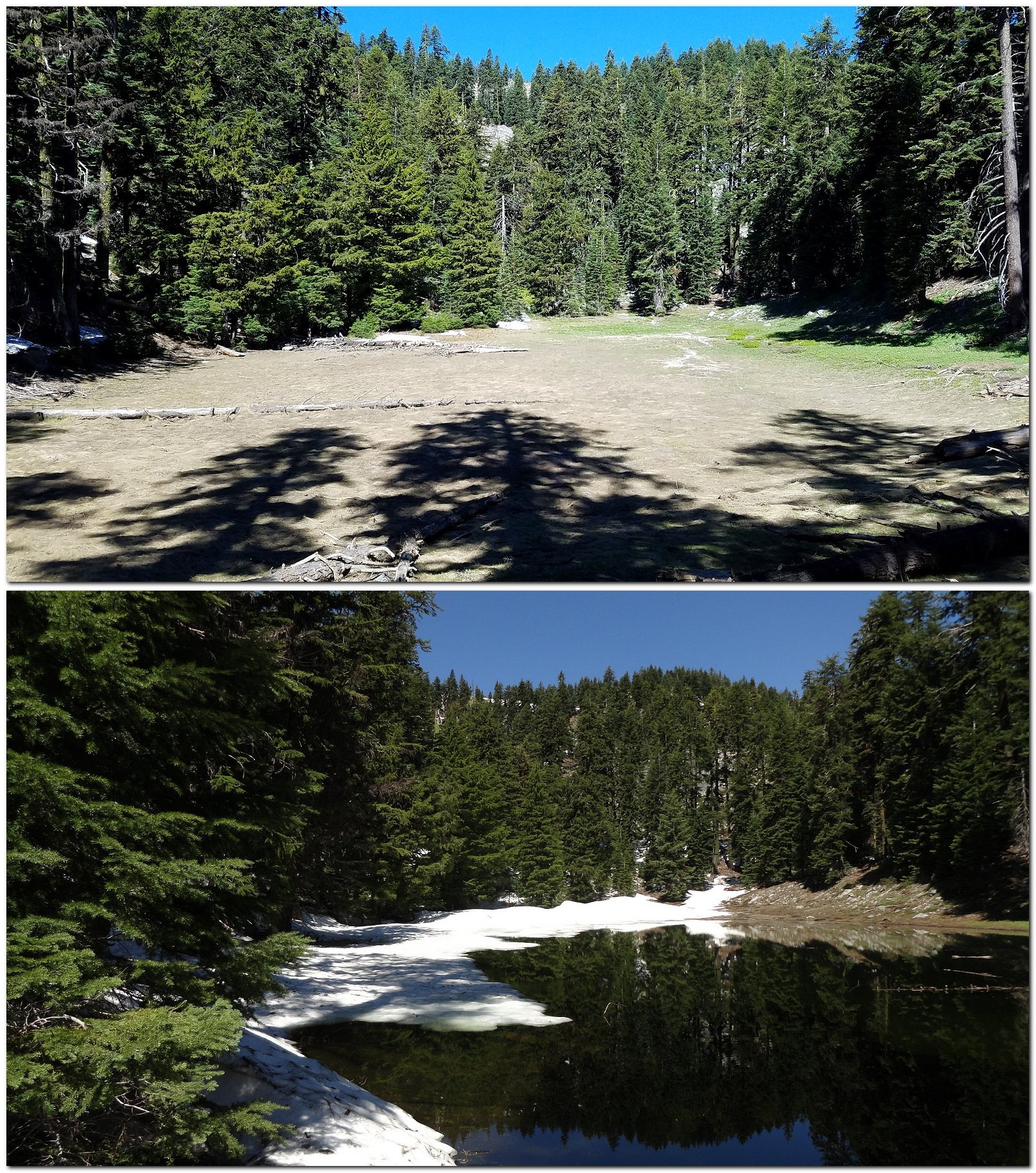
If you know where to look, there is a small lake on southern Oregon’s Mt Ashland.
Top: the lakebed this year. Bottom: the lake full of water on July 4, 2011. The two pictures were taken from about the same place.
Let me qualify that. It’s not actually a lake, it’s more like a large vernal pool. And it isn’t directly on Mt Ashland, it’s on the west wall of Grouse Gap, the big meadow-filled basin that lies just west of Mt Ashland. Mt Ashland forms Grouse Gap’s east wall. But if you get to the right place at just the right time – most of the way, but not all of the way, through the snowmelt season – there is, in fact, a lake there.
Wednesday of this week wasn’t the right time. We were too late: the lake had come and gone, which is the way we commonly find it. We’ve been able to get there when the lake was full only once. But it’s always fun trying.
Yesterday’s hike started early, with breakfast at The Breadboard in Ashland shortly after 7:00 AM, followed by a drive up I-5 and the Mt Ashland Ski Road to Forest Road 20, which heads west from the ski area along the crest of the Siskious, a high landscape of rocky peaks, lingering snow, and wildflower meadows – but very few lakes – to Dutchman’s Peak. By 10:00, following a couple of stops and some really slow driving along heavily-potholed Road 20, we were ready to walk.
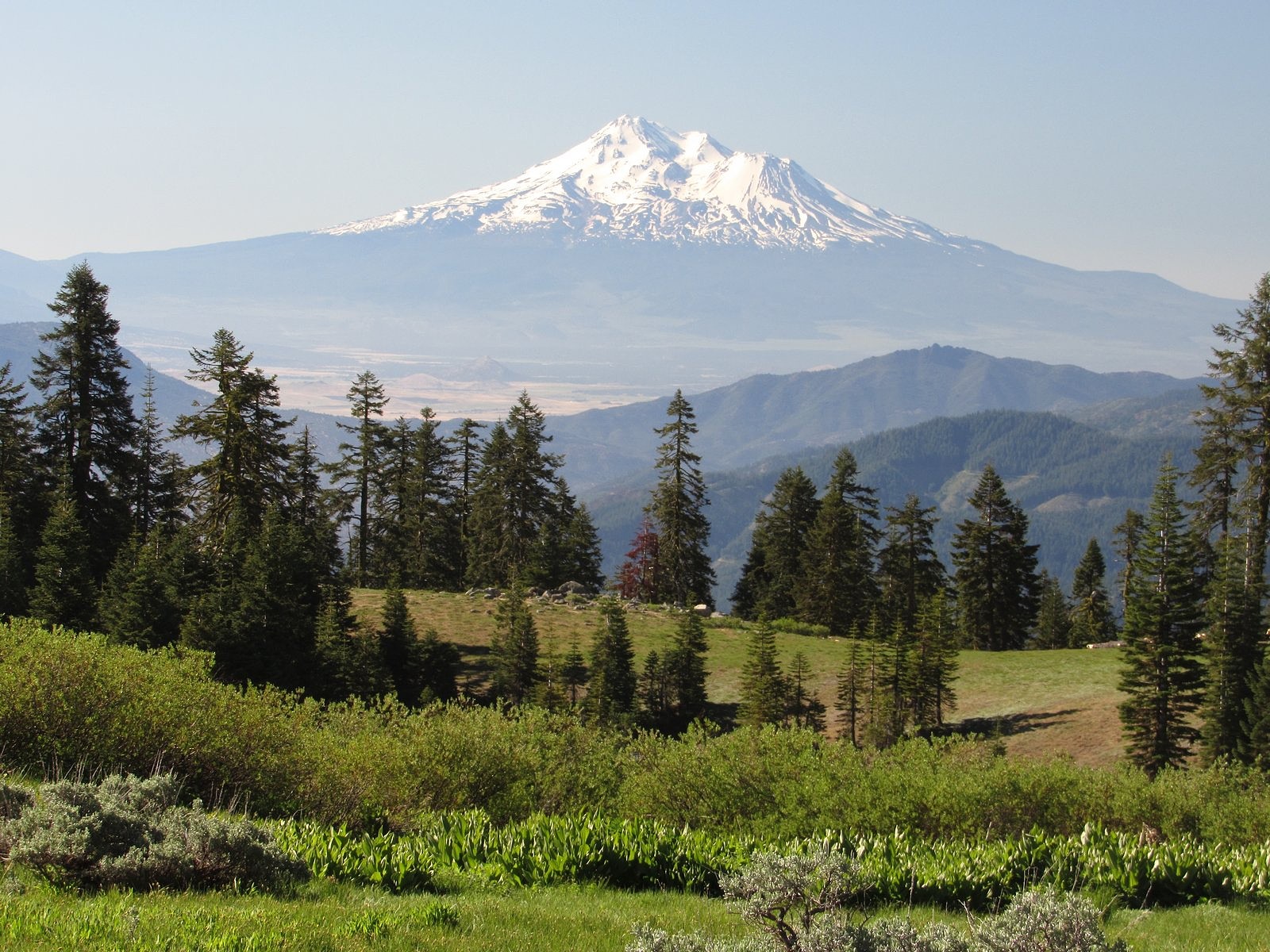
Mt Shasta from Grouse Gap.
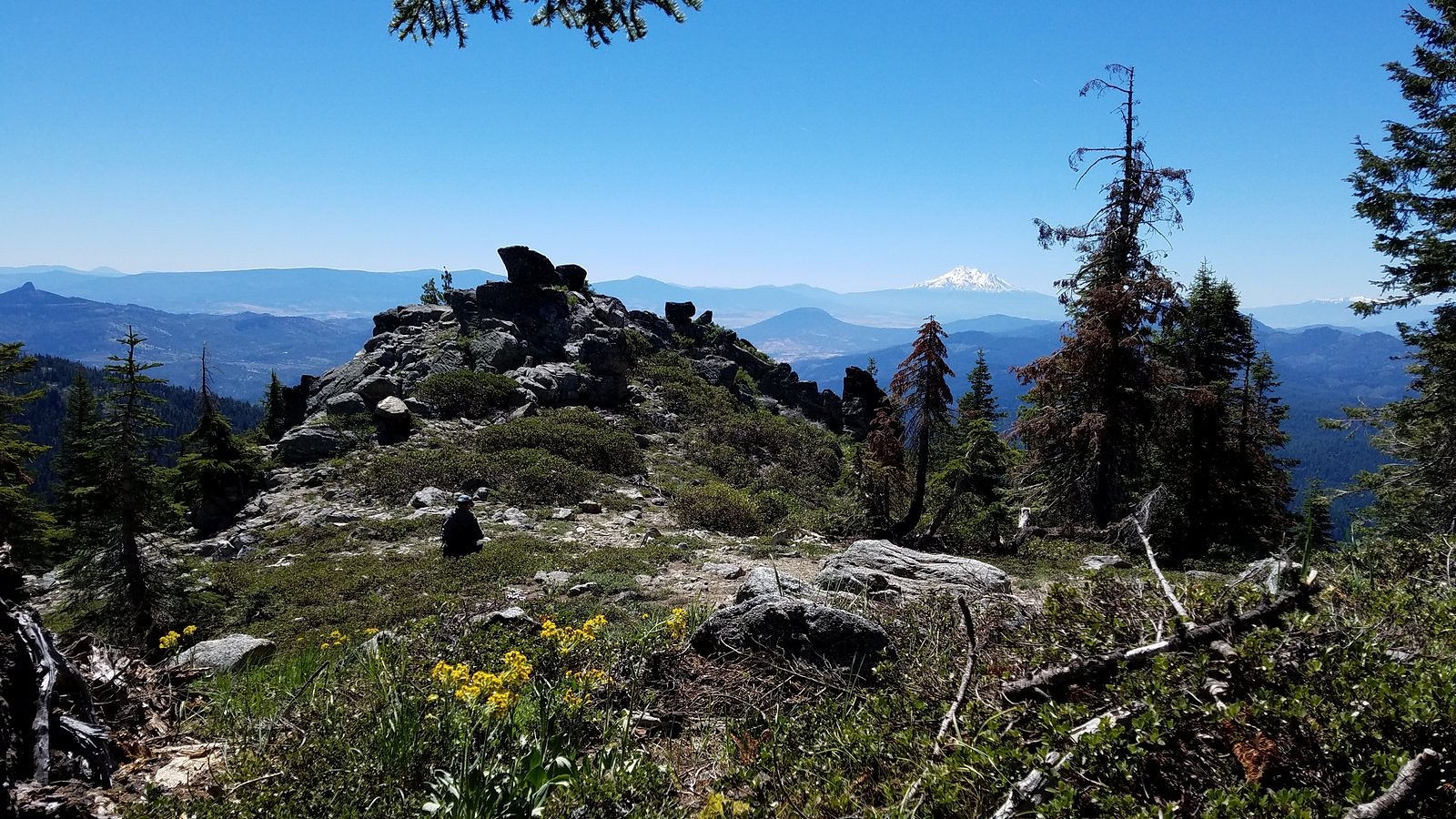
We began on the Pacific Crest Trail, heading west from the Grouse Gap trailhead through meadows and woods to the rocky opening, near the big switchback on the gap’s west wall, where we knew we could see the lake if it was there. It wasn’t, but we decided to go down to look at the lake bed anyway. From the dry lake, we worked our way cross-country to the real goal of the day – a large rock outcrop on the west ridge of the gap we’d been to once before. The combination of rock scrambling, flowers, dramatic dropoffs, and huge views dominated by the double white cone of Mt Shasta make it one of my favorite spots in the Siskiyou range.
Flower photos and granola bars dominated the next hour.
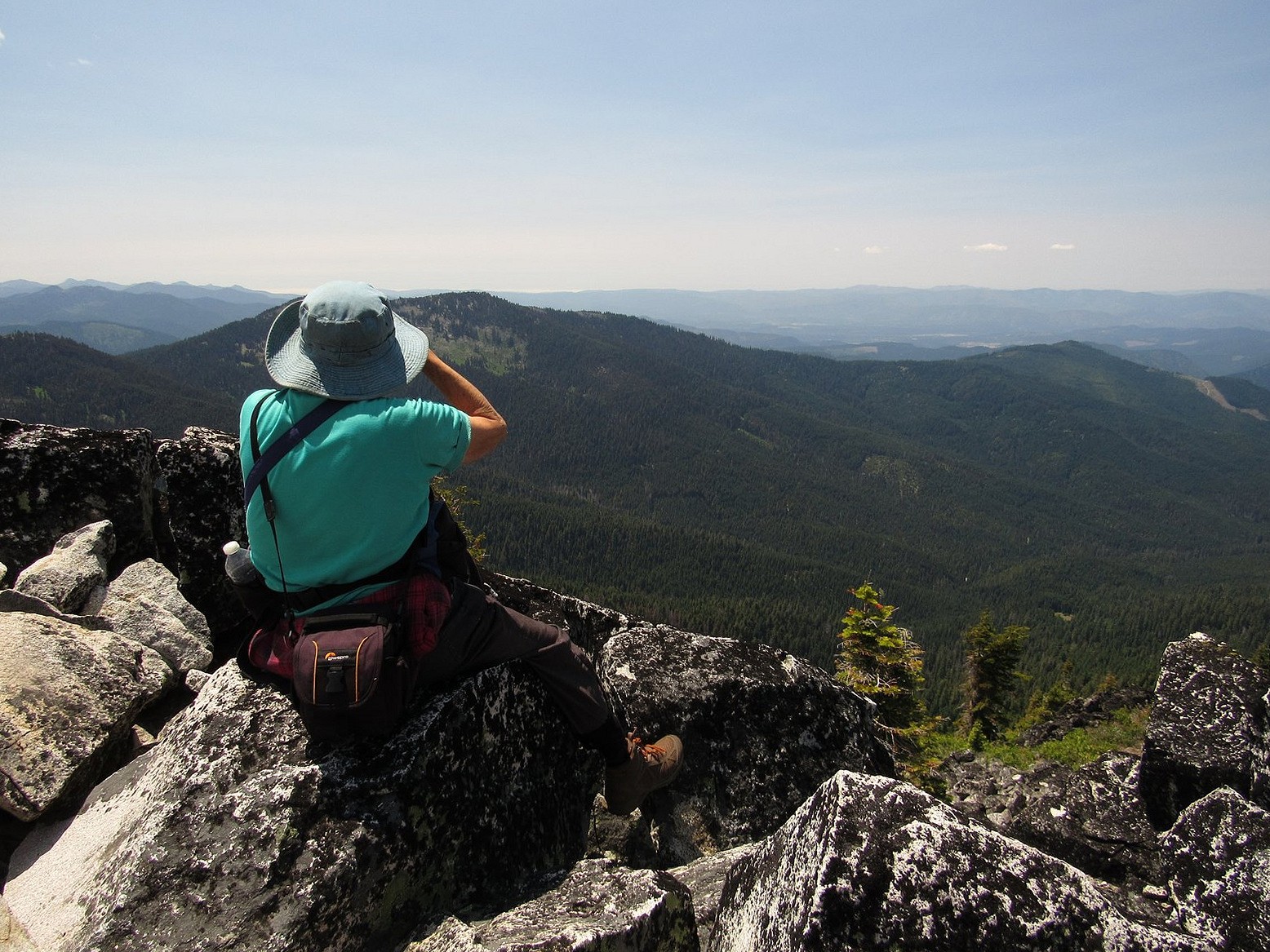
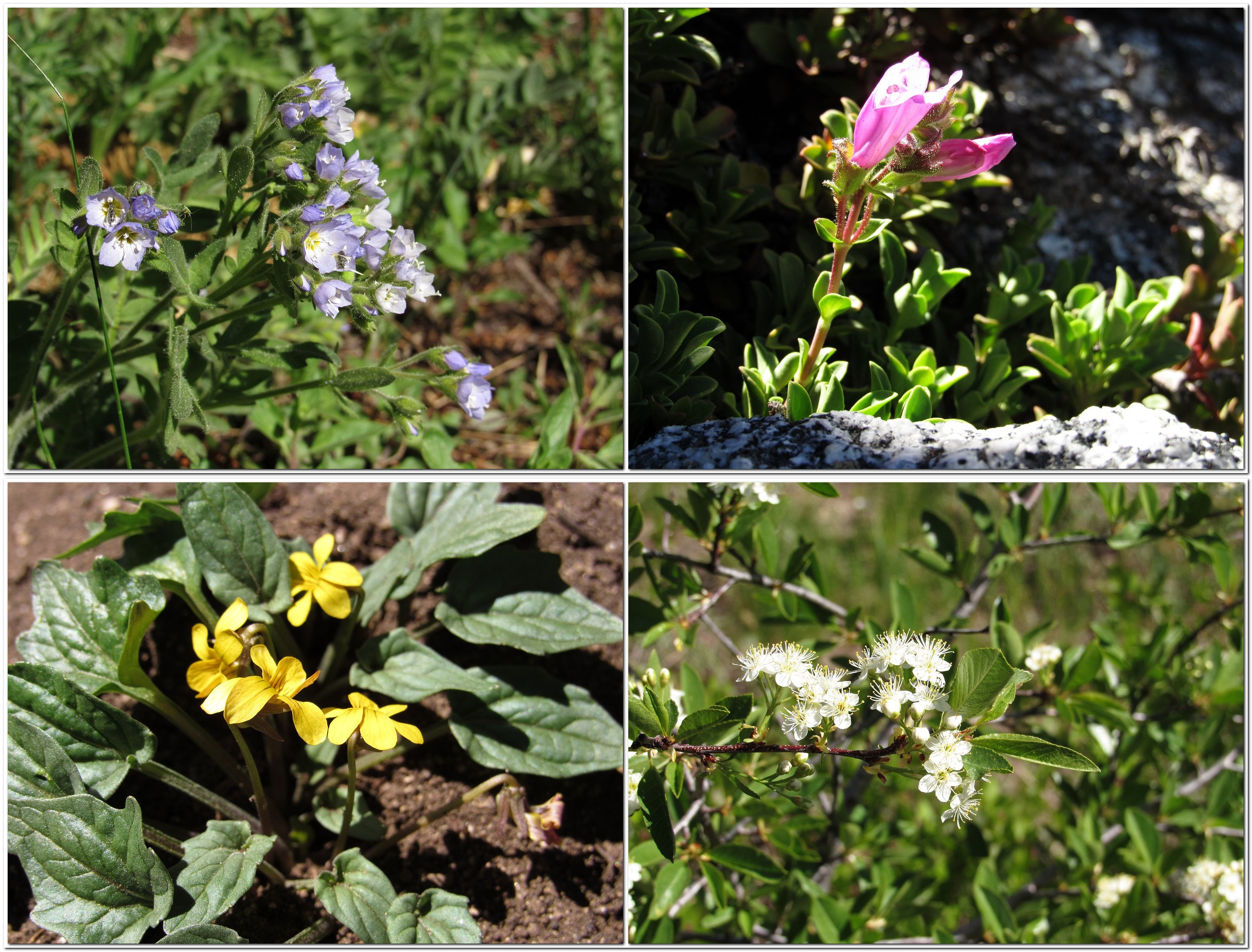
The outcrop, with Melody seated at its base.Clockwise from upper left: showy polemonium, cliff penstemon, bitter cherry, Nuttall’s violet.
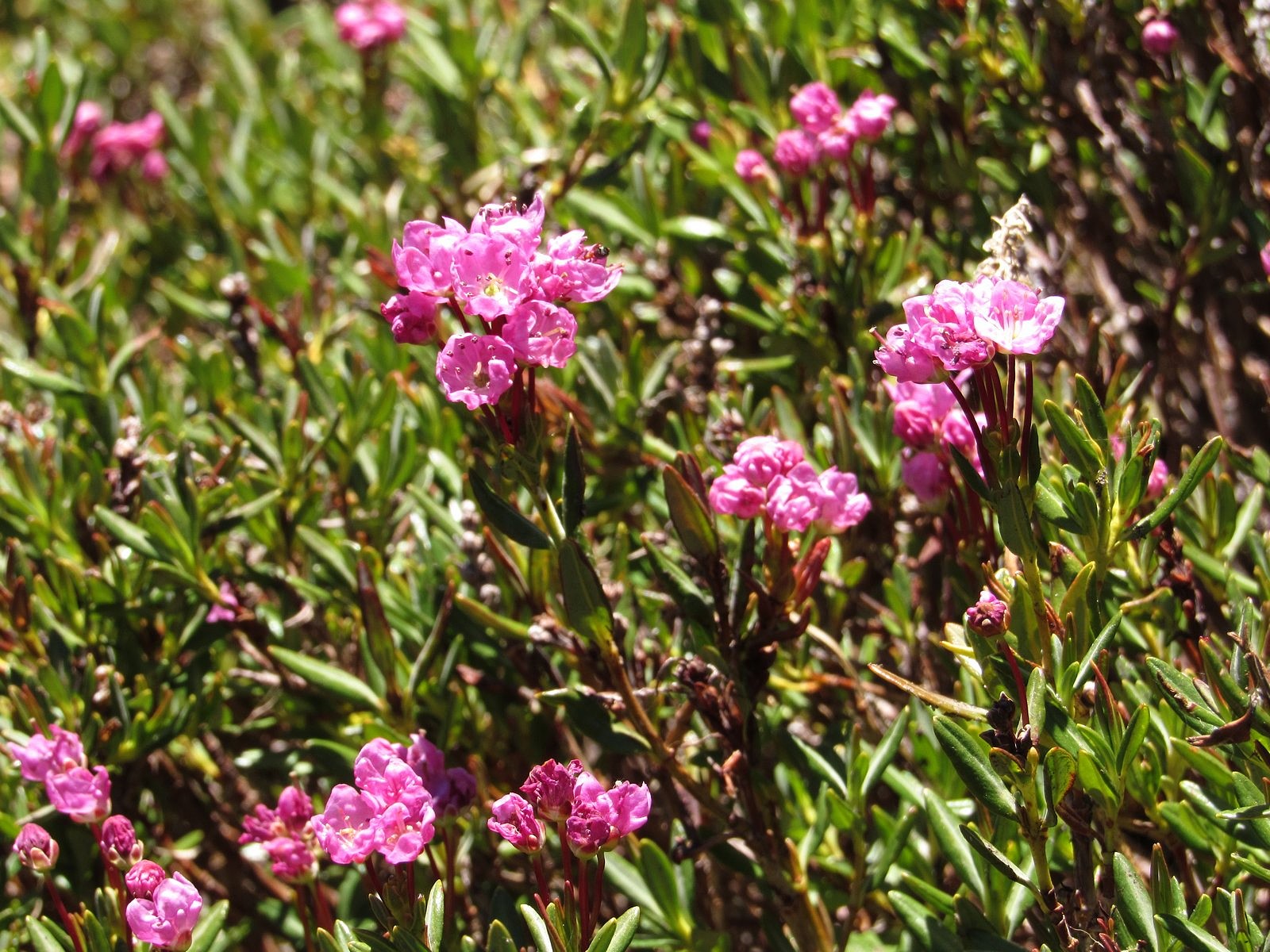
We kept to the ridge on the way back, climbing up and over the unnamed rock knob at its crest and coming down to the high saddle that’s converged on by both the PCT and Road 20 to cross the ridge – the trail and the road are perhaps fifteen feet apart at that point, so you have a choice. We chose to walk the road for a bit. There’s a spring full of buttercups, on a steep, open hillside of small streams lined with kalmia, in the bend where the side ridge we’d been on joins the main east/west backbone of the range, and we often use that hillside to drop from the road to the trail, some distance below. A deep draught of the good juice of the Earth from the spring, a visit to the kalmia – the blooms were fading but still lovely – and we were soon back to the car, ready to head down the mountain and rejoin the rest of the human race.
Kalmia
This is an electric-car blog, so I’ll put in a word here about the great advantage of an electric car over an ICE – internal combustion engine car – for mountain driving. It is 36 miles from our home to the Grouse Gap trailhead, with a 5600-foot elevation gain, most of it in the 20 miles between the Highway 66 freeway interchange in Ashland and the trailhead. Climbing those 5600 feet requires extra energy, in either an electric car or an ICE. What’s different about electric drive is that, on the descent, you gain a fair amount of that extra energy back. An ICE will just burn more gasoline – if only enough to keep the engine turning over and available.
The screen that reports a running total of the number of kilowatt-hours drained from the Bolt’s battery pack since its last complete charge holds the key figure, here. That screen read 16.1 kwh at the trailhead. It read 13.2 kwh at the Highway 66 interchange, meaning that almost three of those depleted kwh had been put back in – the car had only borrowed them. By the time we pulled into our garage, sixteen miles further along, we had used up those three regenerated kwh plus one more – the screen reading was 17.2. We’d used a net of just over one kwh to travel 36 miles. That’s the equivalent, roughly, of 750 mpg in an ICE, on cheaper fuel. Add the Bolt’s rough-road cred – full torque available at all speeds; clutchless application of that torque (allowing finer control for dealing with potholes, puddles, and rocks); and seven inches of ground clearance (two inches more than a typical sedan, and only a little over an inch and a half less than a Subaru Outback), and I can’t for the life of me figure out why anyone would want to drive anything else.
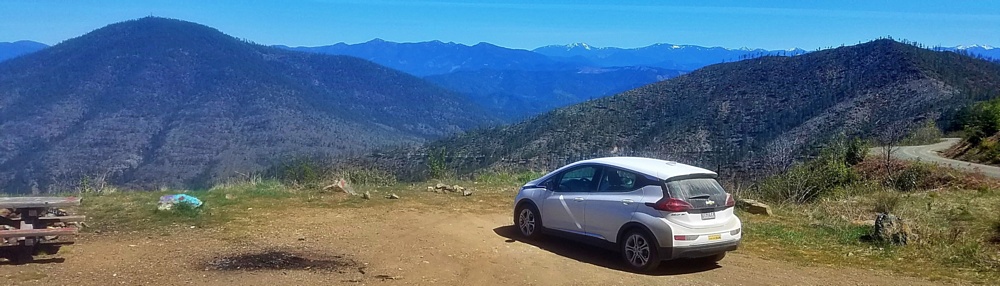
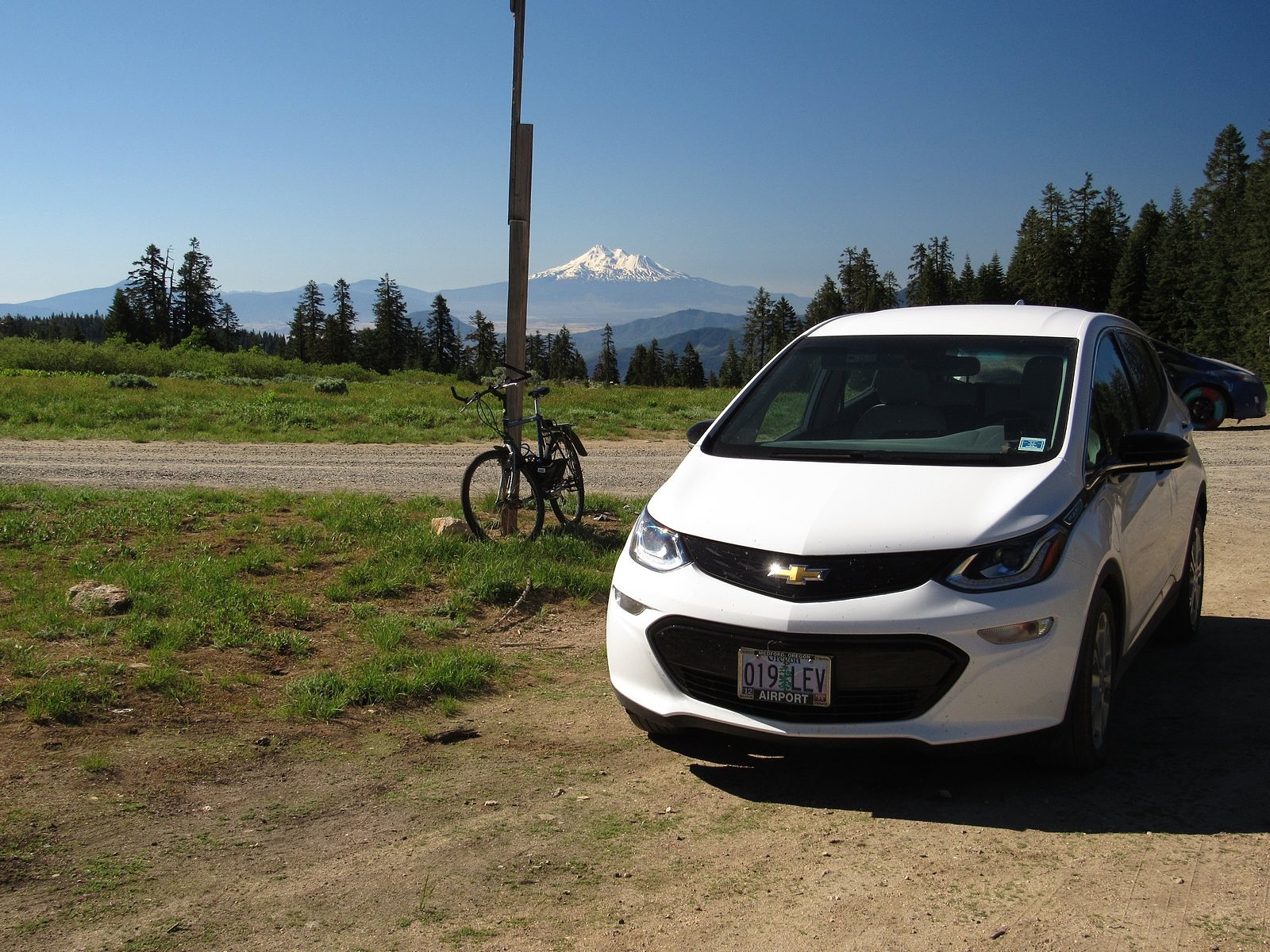
The Bolt at the Grouse Gap trailhead, with Mt Shasta in the background. Lead photo: Mt Shasta over meadow larkspur in Grouse Gap.

 Driving on Sunlight