The new Bolt: GM gets it right / GM still doesn’t get it right

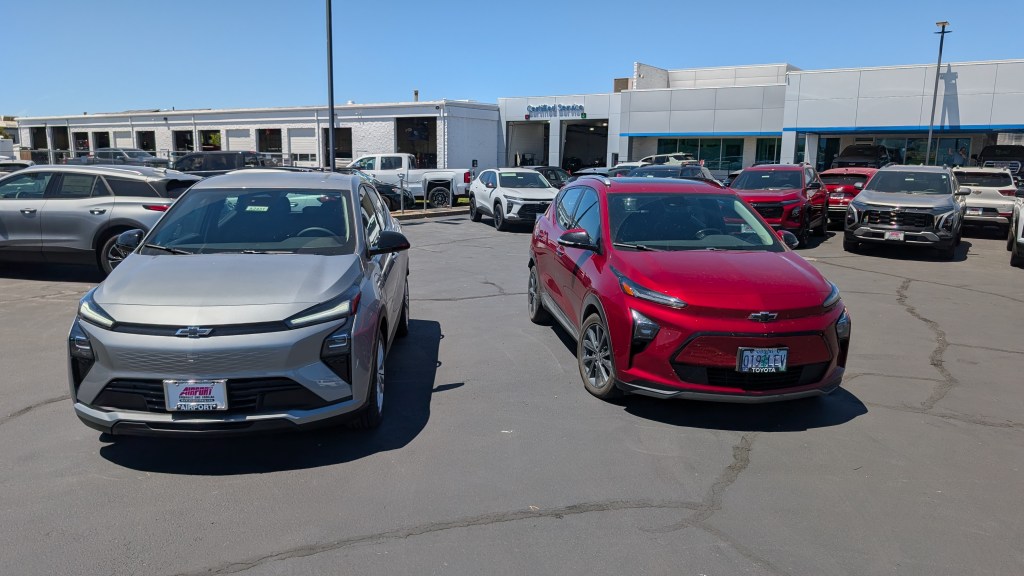
The 2027 Bolt (L) and my 2022 Bolt UV (R)

As the owner of both first- and second-generation Bolts (successively, not simultaneously), I have naturally been curious about the third generation – the car that went on sale, as a 2027 model, in late January of this year. How is the new car different from its predecessors? Are the differences improvements? There was only one way to find out: so a few days ago I went down to Airport Chevrolet, here in Medford, Oregon, to take a look. Here’s what I found.

(A caveat: this was a very quick look. I didn’t drive the car, and I didn’t go into great detail with Drew, the sales rep who was kind enough to show the car to me even after I made it clear that I was there to write about it, not to buy it. I did sit in it (front, back, and driver’s seats), and I played with the infotainment screens a little, and I was able to compare the new version side-by-side with my 2022 Bolt EUV (see the picture, above). And I got Drew’s views, as an EV driver himself – his personal car is the Bolt’s big brother, the Equinox EV – on some of the new gimmicks GM has added to its EV line. I’ll pass an opinion or two of his on to you, along with my own.

About that self-contradictory headline: here’s the thing. What GM gets right is just about everything about the vehicle itself. I have a few minor qualms (you’ll hear about them shortly), but overall, it’s a home run. It preserves everything I’ve liked about the first- and second-gen Bolts, while strengthening many of the earlier cars’ weak points, and it does this while perfectly maintaining the original Bolt’s slightly offbeat ambience – not a easy thing to do after a several-year gap in the model line. What GM still doesn’t get right, though, is its long-term plan for the car. You’d think, after all of the outcries that followed their cancellation of the original, that they would let this one stick around for a good long time. No such luck. The Bolt is back, but only for a limited run. They will be building them for just 18 months: after that, the plan is to shut down the factory and convert it back to – you guessed it – gasoline vehicle production.

Really, General Motors? Do you really think that demand for an excellent, low-priced, much-loved EV like this, with a popular cachet similar to that of the original VW Bug, is going to go away? What, exactly, have you been smoking?

And now, with that out of the way, let’s talk about the car.

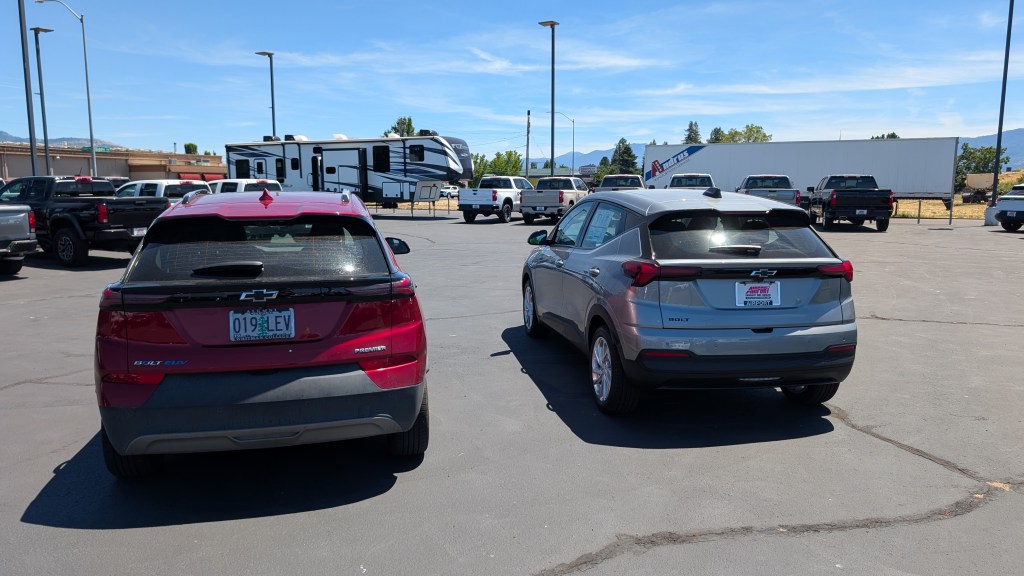
First impressions: this is definitely a Bolt. Detail differences in the front and rear facades aside, it is essentially identical in appearance, inside and out, to the 2022-23 EUVs, and until you learn to look for those little details – things like the slightly reshaped taillights and the thin black line that now connects the running lights across the face of the car – you probably won’t be able to tell them apart. The luggage compartment and back seat are both indistinguishable from my EUV’s. Chevy wisely avoided saddling the new Bolt with the bizarre pop-up door handles they put on the Equinox EV, which remind this old-timer far too much of the highly similar – and blessedly failed – door handles found on the 1955 DeSoto. My worry that they might do this, thankfully, was unnecessary: the new Bolt’s doors open with the same push-button door handles that the old ones’ do.

Things I like: improved visibility for the rear turn signals (they’re now included in the redesigned taillight nacelles, instead of lurking down near the bumper where a car close behind you at a traffic light can easily miss them). A really generous set of storage cubbies in the front cabin, compared with the paucity of small-item storage found (or not found) in the older Bolts. The improved dashboard instrumentation/infotainment system, which clusters more information directly in front of the driver, and makes the rest easily available on the significantly larger – and more user-friendly – center screen. Dumping the proprietary navigation system in favor of a built-in version of Google Maps, meaning that the maps are always up to date, and that they include important things like the hours of stores and restaurants and the current availability of nearby sets of chargers.

Things I don’t like: the climate controls, which are slightly improved over those in my EUV (you no longer have to use the touch screen to change the direction of the airflow) but still can’t match the ones found in the Gen 1 Bolt, which I thought were models of clarity and simplicity. The absence (still!) of a frunk. The gear selector – oh, yes, the gear selector. It is now mounted on the right side of the steering column, where the wiper controls used to be. The wiper controls are now relegated to the left side of the column, where they have been combined with the turn signals into a truly Rube-Goldbergian design that I’m sure my mother would have referred to as a “fearful and wonderful contraption.” They say it was done that way to add extra storage room in the center console, but I dunno. To me, it smacks of change for change’s sake. I’ve seen this movie before.

I’m going to digress a bit here to explain that last sentence. The first car I can remember from my childhood was my father’s 1935 Ford two-door sedan, with bucket seats and a gearshift sticking up out of the drivetrain tunnel between the driver and the passenger. That was the standard design when Dad’s Ford was built. By the time he purchased his next car – a 1947 Pontiac – the designers had become bored with that: gearshifts in almost all American cars had been moved to the steering column, the bucket seats had been replaced by a bench, and that had become the standard design. A decade later, apparently bored again, auto companies had begun experimenting with other possibilities. I took my high school driver training courses in a 1958 Plymouth with a push-button gear selector, not unlike the one I’ve been forced to accomodate to in my EUV. As with the current fling with buttons, those went away quickly, and the gear selector moved back to the drivetrain tunnel between two bucket seats, where it once again became the standard design – completing the circle. I think we’re just watching that same circle start up all over again, just in a slightly different order. Drew stated, when I brought this up, that he really liked the very similar shift lever in his Equinox EV; he quickly got used to it, he said, and to the fearful and wonderful contraption on the other side of the steering wheel. OK. Drew is young. I highly suspect, if civilization survives long enough to allow him to reach my age – a few weeks shy of 84 – that he will have watched the whole cycle run through at least one more time. I think it’s the Book of Ecclesiastes which points out that there is really nothing new under the Sun.

OK: back to the good stuff. I need to say a few words about the 2027 Bolt’s one really major technical upgrade – its new battery chemistry and onboard charging system. Gen 1 and Gen 2 Bolts used lithium-ion (Li-ion) batteries: Gen 3 uses lithium iron phosphate (LFP), which results in batteries that are safer, contain far fewer toxic materials, and are able to be charged all the way to 100% regularly without degrading. On a kwh-to-kwh basis, LFP batteries weigh more; but they are also more efficient. The practical upshot of this is that, although it is heavier, the new Bolt’s range is slightly greater than my EUV’s (EPA 262 miles to EPA 247) – and that its entire range can be utilized on road trips, resulting in fewer stops for charging. (It’s recommended that Li-ion batteries only charge to 80% on Level 3 chargers – the “quick chargers” EV drivers use to refuel on the road).

Charging the new Bolt is also quicker. Gen 1 and gen 2 Bolts are limited to a quick-charger flow rate of 55 kw. Gen 3 owners can quick-charge at up to 150 kw, cutting the hour of charging time my car often requires on the road to about 25 minutes, a distinct advantage. I guess. I’m not completely sold. My current practice is to drive a couple of hours, plug into a quick charger, slip into a nearby restaurant or coffee shop – chargers are almost always adjacent to restaurants and/or coffee shops – and have a nice leisurely cup of coffee or, at appropriate times, lunch or supper. I consider these relaxed stops one of the pleasures of EV touring, and I’m not sure I’d be all that happy trying to squeeze them into the new Bolt’s far more rapid charging time. You gain a little, you lose a little. Sometimes you lose a lot.

To round out the multiple changes to the battery and charging systems, the new version is equipped with a NACS (North American Charging Standard) charging port, rather than the CCS (Combined Charging System) port found on earlier Bolts – meaning that the newer car can use the widespread and highly dependable Tesla nationwide charging network without an adapter. It now requires an adapter for CCS plugs, though, or for J1772s – the standard connectors for the level 2 chargers found in home garages and, increasingly, at motels and restaurants – so they’ve really just moved the deck chairs around. As with the new car’s charging time, the gain is at least partially offset by the loss.

Bottom line: will I buy a 2027 Bolt? No. I have no urge to replace my EUV, which is – except for the instrumentation and battery/chargins system changes – almost exactly the same car. Do I recommend it to others? Definitely. These are really sweet little vehicles. They punch above their weight: they may look small from the outside, but there’s a surprising amount of room inside, and they drive like a much larger, pricier car. When I am asked to sum up my EUV’s appeal in one word, that word is always competent. If I ask it to do something, it does it. No flash, no drama: just solid, matter-of-fact, dependably spot-on performance, every time. If that sounds boring, you probably don’t want this car. If it doesn’t – if competence, refined driving feel, ridiculously low fuel costs, and a touch of luxury (at least in the higher trim lines) sounds enticing – then you might consider picking one of these small jewels up. Quickly, before GM cancels production again.
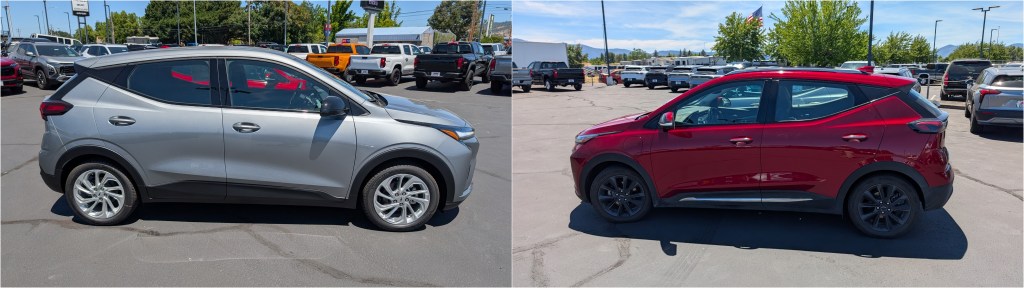
2027 on the left, 2022 on the right.
Rear view. 2022 on the left, 2027 on the right.
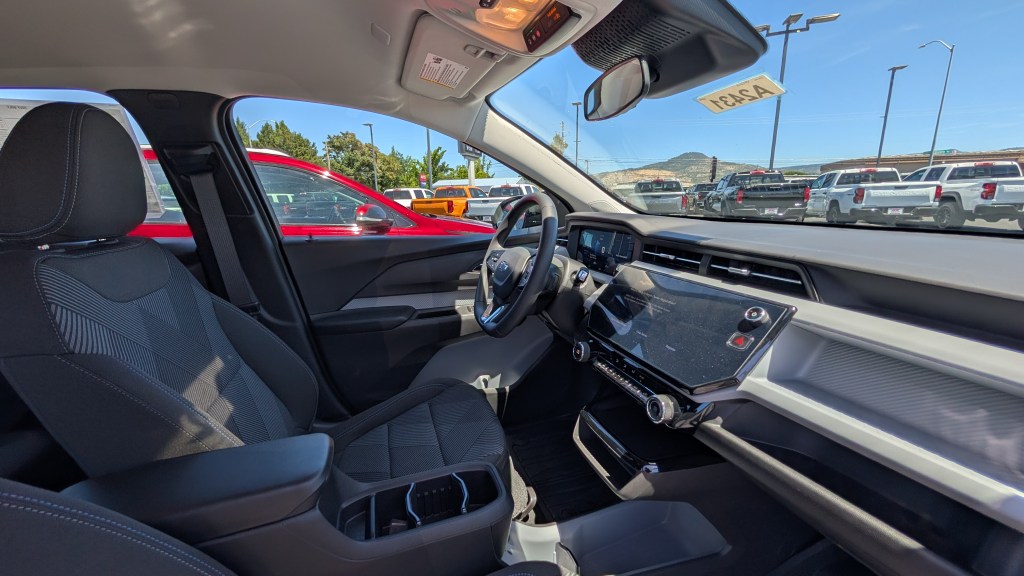
The 2027 cockpit.

Bolt EV fires (or not): the continuing storrrry……

Two recent developments regarding the Bolt EV battery fires seem worth reporting here.

First, battery replacement seems to be going well. It certainly went perfectly for ours. I dropped the car off at our dealer (Airport Chevrolet in Medford, Oregon) at 8:00 AM on January 11 and drove home in the loaner that was waiting for me. At 4:00 PM that same day I got a call informing me that the work was done, so I got back in the loaner and drove back to the dealer. The Bolt had been washed and vacuumed, and its new battery had been fully charged; the Guess-O-Meter (range indicator) read 250 miles, an almost un-heard-of number for the original battery in mid-winter. That, and the paperwork giving my three-year-old car a full new-car warranty on its battery, were the only signs that any work had been done at all. The charge for everything, including use of the loaner, was zero. Not a bad reward for simply giving up access to my Bolt for eight hours when I wouldn’t have been using it anyway (the loaner just sat in our driveway all day).

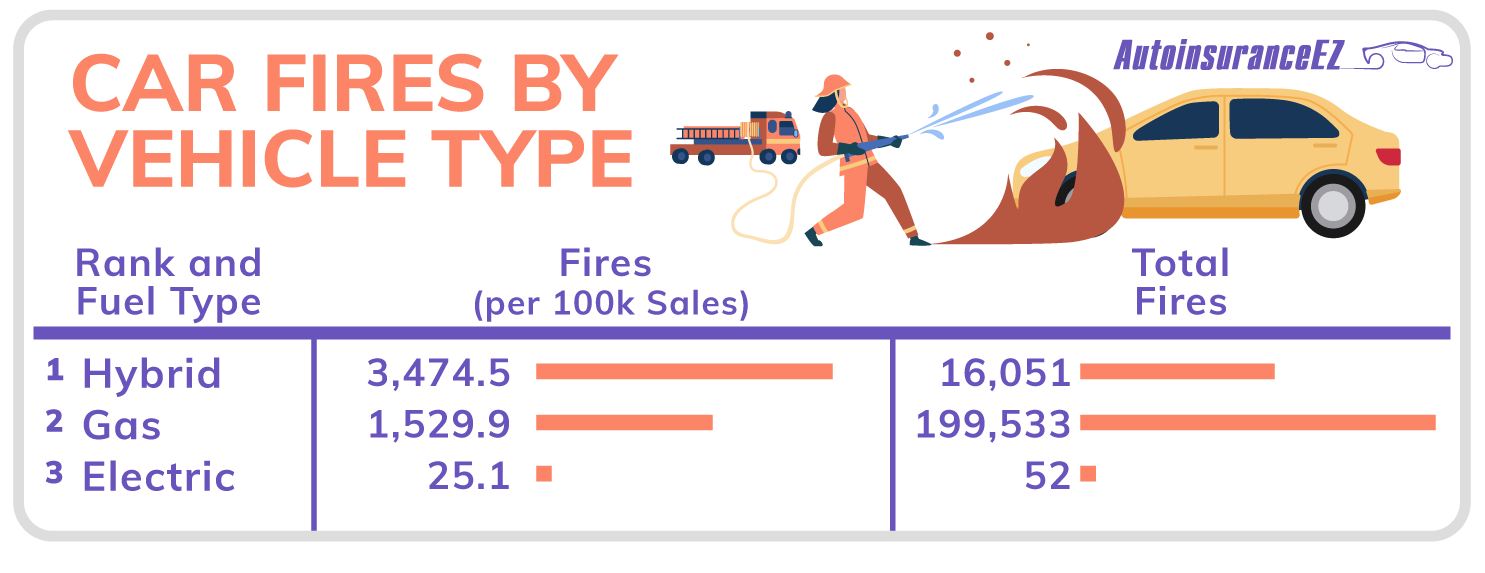
Second, a recently-released insurance-industry study has now provided undeniable proof of what I have maintained all along: even with their old batteries, Bolts (and other EVs) are far, far less likely to catch fire than your average gasoline-powered chariot. The website autoinsuranceez.com collected all the vehicular fire data they could find from the National Transportation Safety Board (NTSB) and the Bureau of Transportation Statistics (BTS). Here’s the graphic they published to summarize what they found:

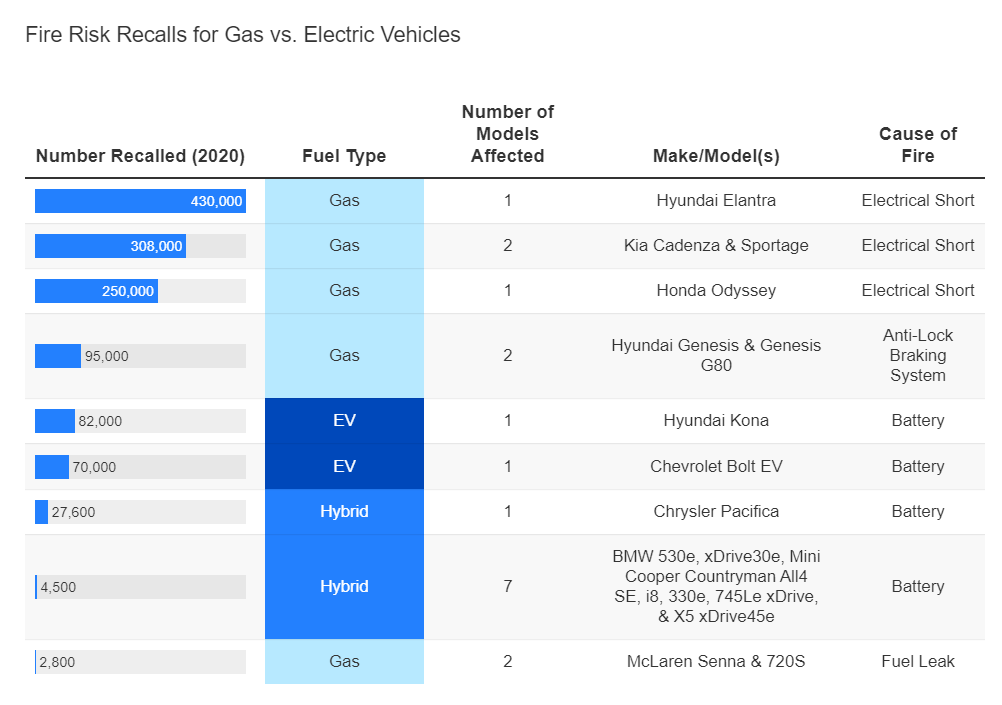
They also visited Recalls.gov to find out how many fire-related vehicle recalls had been reported to the government in 2020. Here is that data, broken down again by vehicle type:

Once more, by far the greatest majority of fire-related vehicle recalls were for gasoline-powered cars, both in numbers of brands and in total numbers of units.

Viewed through the lens of these figures, all the hype over the Bolt fires seems kind of silly. It turns out that Bolt owners have been safer than gasoline-car owners all along. EVs – including Bolts – catch fire at less than two percent of the rate that ICE (internal combustion engine) cars do. For this, GM asked owners to park outside after charging? For this, Bolts were banned from parking garages and employees’ parking lots? The recall itself seems reasonable enough to me (after all, there was an unnecessary risk of fire, no matter how small); the attention paid to it doesn’t. The press jumped on the issue because EVs are still a new technology, and everything about them is newsworthy, especially if the news can be sensationalized. But GM shouldn’t have followed suit. The auto company’s best approach would have been to publicize the same figures that autoinsuranceez.com found – they’re readily available, and always have been. Instead, GM – in what they themselves described as “an excess of caution” – chose to emphasize how careful they were being with consumers’ safety. It probably seemed like a good idea, but it backfired. The message consumers got wasn’t “we care about you,” but “Bolts are likely to catch fire.” The gambit failed, and we are likely to pay for it by much slower adoption of electric vehicles over the next few years.

Which would be a shame. Because the other thing I found out from my own experience with the recall was this: EVs run rings around gasoline vehicles by just about any measure you can apply to them. The car that Airport lent me was a brand-new Buick Encore – a small luxury SUV – sporting just about every bell and whistle known to humankind. It had all of 1500 miles on the clock, and everything about it was fresh as a daisy. But it was also the first ICE I had driven in over three years, and it felt unbelievably primitive. The sluggish response to the accelerator – the noticeable shifts in RPM as the automatic transmission climbed through its gears – the lack of braking response when backing off the pedal – all of these things reminded me during pretty much every second of each of my two drives that internal-combustion engines are really unsuited to powering vehicles. Pistons, crankshafts, clutches, and transmissions are all kludges required to control an undirected explosion and make it turn something. EVs don’t need them – electric motors are turning already. My Bolt is a basic model, far down the scale of luxury, but after just a few minutes behind the Buick’s wheel, I could hardly wait to get back behind my own.

On Fires, Electric Cars, and General Motors

(Note: This post has now been updated twice. See the notes at the end.)

Bolts have been catching fire. In their response to these fires, General Motors has taken an incremental approach that is seriously damaging their reputation and the reputation of electric cars in general.

To recap what you probably have already learned from other sources: the battery packs in a small number of Chevrolet Bolts – GM’s iconic small electric crossover, and the car this website and blog are based on – have caught fire, totaling the cars and damaging or destroying their owners’ garages. GM has dealt with this through a series of recalls. The first of these recalls, widely advertised as “temporary,” installed a simple software patch that prevented the cars’ batteries from charging to more than 90% full while the problem of the fires was being researched. The second, five months later, was more complex: dealers’ service departments tested the car’s batteries for cells that exhibited what GM’s engineers thought was the flaw that caused the fires, replaced any battery modules where the defect was found, and installed new battery-management software that watched for the flaw and warned owners if and when it developed. This was announced as a “permanent” fix.

It wasn’t. Fires continued to be reported, including at least two in Bolts on which the “permanent” fix had been performed.

Last week, GM announced a third recall. Armed with new theories about what has caused the fires, plus statistical information on the dates of manufacture of the burning vehicles, they plan to check certain ranges of VIN numbers, aggressively retest the batteries, and replace every module that shows a hint of the problem, up to and including entire battery packs, if necessary. This is a laudable upscaling of their response.

It isn’t adequate.

Before getting into the reasons for that, it seems necessary to dispel a few misconceptions about the fires. The first has to do with their frequency. As of the last report of which I’m aware that gives actual numbers rather than estimates (Green Car Reports, 7/23/2021), nine Bolt battery packs have caught fire. Almost 100,000 Bolts have been sold in the United States since the car was introduced in late 2016. Even if we limit our scope to the early run of the 2019 models, when the overwhelming majority of the cars involved in the fires were manufactured and sold – the last four months of 2018 and the first four months of 2019 – we are dealing with a maximum of nine fires out of more than 13,000 vehicles. That is not exactly a high-risk percentage.

The second misconception is about who is to blame. Although GM is correct to recall the cars – and Chevrolet technicians will be doing the work – the auto company did not manufacture the faulty batteries. Like almost all cars today, Bolts are a conglomeration of parts built by various subcontractors in various parts of the world. The batteries were built by the giant South Korean chemical and electronics firm LG Chem, and all of the defective units discovered so far have come from a single LG plant, in Ochang, South Korea. LG has partnered with GM in the various recalls, but so far they have adroitly managed to sidestep public responsibility. This should change. GM should no longer have to take a fall for another company’s shoddy workmanship.

The third misconception is that the fires have been random. Actually, almost all of them have taken place under the same circumstances: they involve batteries that have been discharged nearly to zero and then taken to completely full in a single charge. This is normal refueling behavior for drivers who have learned their habits in gasoline-powered vehicles, but it’s wrong for lithium-ion batteries, which do best on many shallow discharges rather than on a few deep ones – meaning that they should be recharged at every opportunity instead of only when the car’s range drops so low that a charge is necessary to make it to the next charging station. Batteries also heat up while being charged, behavior that gets more extreme during the last few percent of a full charge. This last characteristic is why GM’s original quick fix was to install software that cut off the Bolt’s charging at 90 percent, and it is also why the company currently advises owners to use the car’s native charge-limiting settings to reinstate that 90 percent limit while waiting for the most recent recall to be performed (they also suggest that the available range shouldn’t be allowed to drop below 70 miles, to avoid the deep discharges that seem to be a large part of the problem).

So: if the fires are extremely rare; if the risk can be minimized even futher by proper battery care; and if it isn’t GM’s fault anyway, why do I consider the current recall – which is solely to detect and replace battery modules exhibiting the fault that GM and LG engineers now believe to be the real cause of the fires – seriously inadequate?

Full disclosure, here: my own Bolt is a 2019 with a battery from that suspect South Korean plant, and with manufacture and sales dates (August and December, 2018) that put it right in among the cars that have been most likely to burn, so these things are likely to influence my state of mind. But that is precisely the point. A recall like this is certainly about safety – no one wants to see more Bolts catch fire – but it is even more about state of mind. The actual risk that any given Bolt will catch fire is vanishingly small; the risk that it will catch fire during the next 24 hours is even smaller. As an environmental writer, and the son of a scientist, I understand the minute nature of these risks quite thoroughly – intellectually. I still go to bed each night with a niggling fear that I will be awakened by a smoke alarm, and I now shy away from taking trips that will run the battery gauge below five bars (out of twenty) before the next charge begins.

The currently announced recall isn’t going to change that. Testing for faulty modules and replacing them might have seemed adequate last time, but that last time turned out to be a failure. It did not breed confidence that testing and replacing individual modules will do the job now. To regain consumer confidence in the product, nothing less than full replacement of every questionable battery pack will do. This is especially true of the early 2019 models that have experienced the great majority of the fires, but it is actually necessary for every first-generation Bolt battery built in the Ochang plant. All of them are now suspect. Whether or not that suspicion is deserved is beside the point: Bolts – and, by extension, electric cars in general – will remain under a cloud of doubt until and unless full replacement is done.

GM needs a recall designed by politically savvy engineers. It has given us one designed by accountants and lawyers. It apparently aims, not to protect Bolt owners, but to spend the least money possible to gain the company the greatest possible protection from lawsuits. On that last point, GM’s own language in the recall notice is instructive:

Out of an abundance of caution, you should continue to park your vehicle outside immediately after charging and do not leave your vehicle charging overnight.

This is in direct contradiction to the advice given in the owner’s manual:

It is recommended that the vehicle be plugged in when temperatures are below 0°C (32°F) and above 32°C (90°F) to maximize high voltage battery life.

To paraphrase that last statement: leaving the car plugged in will allow its battery-management tools to do a better job. If that is true, then unplugging it and moving it outside will cause those tools to do a worse job, which will increase the risk that the battery will catch fire. Only a corporate lawyer would advise making the risk of a car fire greater in order to reduce the liability risks to his client should the car fire cause its owner’s house to catch fire as well.

I am continually appalled at the damage fossil-fuel use does to the environment, up to and including climate change. I also love electric cars for themselves, and I particularly love the Bolt. It would be a shame if excess financial and legal caution on the part of General Motors led to fewer Bolts, fewer electric cars in general, and an increased likelihood of runaway damage to the planet.

Update on August 20 – General Motors has just announced that all battery modules in all Bolts will now be replaced (including those in the new extended version known as the EUV). They are “aggressively seeking” compensation from LG for the costs they will be incurring. The new modules will be the current version, so those of us driving older models will see an 8% improvement in range, as well as receiving an updated warranty that will cover the new battery modules for 8 years or 100,000 miles. I’m happy to see GM stepping up to the plate on this one.

Update on September 29 – General Motors has now announced that production of Bolt batteries has resumed, and that replacement of the existing battery packs under the recall will begin by mid-October. LG has changed both its manufacturing processes and its quality-control protocols, and both the battery company and GM are assuring customers that this time, they have it right. As further insurance (and assurance), the auto company will be installing new diagnostic software in all Bolts, which will provide better monitoring for abnormalities in the performance of the batteries. Priority will be given to the owners of Bolts built during “certain timeframes” where battery problems appear to have been clustered: if I understand this correctly, it means that the first cars to undergo battery replacement will be those built in October and November of 2018. Ours was built in August of 2018, so it won’t be among the first. The second wave, though is likely to be the rest of the 2019s, so we can probably expect replacement before the first of the year. I’m looking forward to the 8% longer range – in our car, that should mean about 20 extra miles.

The extra assurance will also be nice, although I’ve never been particularly concerned that my car will catch fire. The odds are overwhelmingly against it, despite the fear-mongering that has taken place. There have been reports of parking garages who won’t allow Bolts inside, and of employers who have told Bolt owners that they can no longer charge at work. That’s on top of the fears of owners themselves, far too many of whom have been caught up in the hype. The Bolt owners’ Facebook page has been full of people angry that they have to drive “firebombs” and worried about how strictly they have to follow GM’s recommendations to avoid burning their houses down. A few are announcing bitterly that they will never buy an electric car again. This despite the fact that ICE (internal combustion engine) vehicles still catch fire at a far higher rate than EVs. Lost in the hype over the Bolts, for instance, is the fact that BMW just recalled 185,000 cars (nearly twice as many as are affected by the Bolt recall) to fix a problem that – you guessed it – might cause them to catch fire while parked.

So for those people, I’ve done a little further math. As of September 20, GM had confirmed fires in 12 Bolts. That is 0.012 per cent – 12 thousandths of one percent – of all Bolts on the road. For comparison, using figures provided by the insurance industry and by the federal government, I’ve computed the likelihood of house fires caused by cooking accidents. It’s roughly 0.2 per cent – nearly a full order of magnitude larger. You have a far greater chance of catching your house on fire while cooking dinner than you have while charging a Bolt in your garage and leaving it plugged in after charging.

I think I’ll stay relaxed.