Refueling

What it’s really like to take an electric car on a road trip.
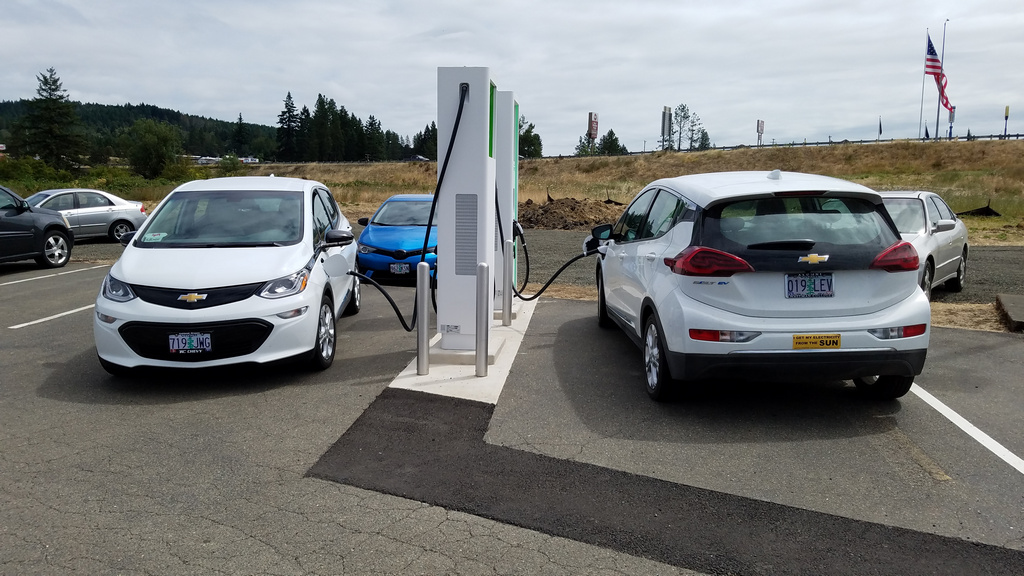
At the charger in Sutherlin – not the first time we’ve shared a set of charging stations with another white Bolt. Ours is the one on the right, with its back to the camera.

I’m one trip behind on hike reports, but I thought I should do this first. We’ve just returned from a week in McMinnville, Oregon – a small town near Portland, 250 miles from our home in Medford. That is a “maybe” distance for an electric car: maybe we could make it all the way if we start with a full battery, but maybe not. So prudence dictated a refueling stop each way, as well as at the destination. And because the process of refueling an electric car on the road is broadly misunderstood, it seems useful to try to clear up some misconceptions by describing exactly how it worked on this particular trip.

One caveat: it is still necessary to plan carefully. This has nothing to do with the actual recharging process, and everything to do with the state of the charging network. There are gas stations just about everywhere, but charging stations are still few and far between. I dream of the day when there are charging stations on every corner and it’s the drivers of gasoline vehicles who have to plan, but we have to deal with reality. I had to choose in advance where to stop along the way, and I made reservations far ahead in the single reasonably-priced motel in McMinnville that has a charger in its parking lot.

Once that part is out of the way, though, the rest is easy. It is actually simpler to charge an electric car’s battery than it is to fill a gas tank, and it takes less time out of your trip. Let me repeat that: it is actually simpler to charge an electric car’s battery than it is to fill a gas tank, and it takes less time out of your trip. The horror stories you hear about how dreadfully long it takes to charge are probably true for the people who experience them, but they result from failure to understand that charging a battery is not like filling a fuel tank. It’s a different process, and requires a different way of thinking.

With a gasoline car, the usual procedure is to run the car until the tank is nearly empty, then pull into a gas station and fill all the way up. While it’s filling, you stay with the car. If the gas station is also a convenience store, you may run in to buy a bag of potato chips or a cup of coffee to go; otherwise, you just wait for the ten or fifteen minutes it takes the tank to fill. With an electric car, that model simply doesn’t work. You’re rarely going to fill the battery all the way up – that’s not even a good idea (doing it regularly can shorten the battery’s life). And you don’t need to stay with the car. While the charger is doing its thing, you can be off doing something else. Here’s how that works – actual experience, on our trip that ended yesterday.

PLANNING: I started by trying to find out whether we would be able to charge the car in McMinnville. The best tool for this is the Plugshare website (plugshare.com), a crowdsourced site that attempts to map and describe every public charger in the country. We would be spending the first two nights in a motel before moving to a dorm on the Linfield College campus, so I looked for motels with “destination chargers” – level 2 (220-240 volt) chargers located at places where you expect to stay a long time, such as overnight. McMinnville’s Best Western had such a charger. I called to see if we could reserve it; the answer was “no”, but the woman I spoke with said it was rarely used. That seemed satisfactory. I booked a room.

Next, I visited A Better Route Planner (abetterrouteplanner.com), a routing site designed specifically to help electric-car drivers find the most efficient routes for long-distance travel. It suggested a charging stop in Sutherlin, a small town just north of Roseburg, to boost the battery up to 71%. That, it said, would be enough to reach McMinnville with about twenty miles to spare. Estimated time on the charger would be 13 minutes. I checked out the Sutherlin charger on Plugshare and found it had a 10-star rating (out of 10) and four charging stations, which meant we could probably count on getting the charge started immediately. It was also next to a Dairy Queen and near a Starbucks. I penciled it in. Planning was complete.

THE TRIP NORTH: The night before our departure, I reset the top charge on the Bolt from 95%, where we usually keep it, to 100%. That would be insurance against broken or full chargers. As I backed the fully-packed and fully-charged car out of the garage the next morning, I noticed that the range indicator said we had 307 miles, which would get us to McMinnville with more than 50 miles to spare. That, of course, was based on running around Medford, rather than dashing a couple of hundred miles at freeway speeds with the air conditioner on. We decided to stop at Sutherlin anyway.

The drive went smoothly. At Sutherlin I plugged in, inserted my credit card, and had electricity flowing into the car in about a minute and a half. We had nearly 60% of the battery left, so we decided 10 minutes of charge would probably do. We slipped into the Starbucks, and those 10 minutes stretched to nearly half an hour, giving the car an 83% charge. I unplugged – about a 30-second procedure – and we headed for McMinnville, taking the shorter but slower Territorial Highway instead of the freeway route that A Better Route Planner had suggested. That got us to the McMinnville Best Western with 100 miles of range left. The charger’s parking slot was empty and the charger was a SemaConnect, for which we carry a charge card. Plugging in and starting the juice flowing took all of about 45 seconds. We would wake up the next morning with a full battery. It would take about 5 seconds to unplug.

THE TRIP SOUTH: We didn’t use the car much for the five and a half days we spent in McMinnville, so we didn’t bother charging again. Pulling out of town in the early afternoon, I noticed that we had a 95% charge – plenty to get back to Sutherlin, where we stopped and plugged in again. The charger told us it could get the car back up to an 80% charge in 40 minutes. It was just before 5:00 PM, so we went to the Dairy Queen and grabbed a meal. We finished eating with about ten minutes left of the estimated 40. The battery was up to 74% – more than enough to get to Medford – so I stopped the charge and unplugged. We changed drivers and Melody drove us the 110 miles home, at freeway speeds, with the A/C on and the outside temperature hovering above 90°F. We pulled into the driveway with 77 miles of range left.

ANALYSIS: Adding up the various plugging and unplugging times, you’ll find that we spent under five minutes charging the car. The car actually charged much longer than that, of course, but it’s really our time that counts, and while the car was charging, our time was spent doing things we would have done anyway. I wanted to stop for coffee, anyway; we would have slept in the motel all night, anyway; we would have made a dinner stop someplace on the way home, anyway. By combining those stops with charging, we had actually saved time over what it would have taken us to fill a gas tank twice. Or even once.

So that’s what it’s really like to make a 500-mile round trip in an electric car – a car that is as capable as any vehicle I’ve ever driven, and more fun than most. And it’s probably worth adding that the Bolt’s small appearance is deceptive. We got all we needed for a week – including our clothes and toiletries, a guitar, a laptop, a box of papers for the conference we were attending, and the car’s wall charger (just in case) – into the covered space behind the back seat, and we carted three extra people around McMinnville for part of the time we were there. Aside from the planning time needed, there was literally no downside to taking the Bolt instead of taking a gasoline-powered car. Ignore the naysayers. Welcome to the real future of driving.
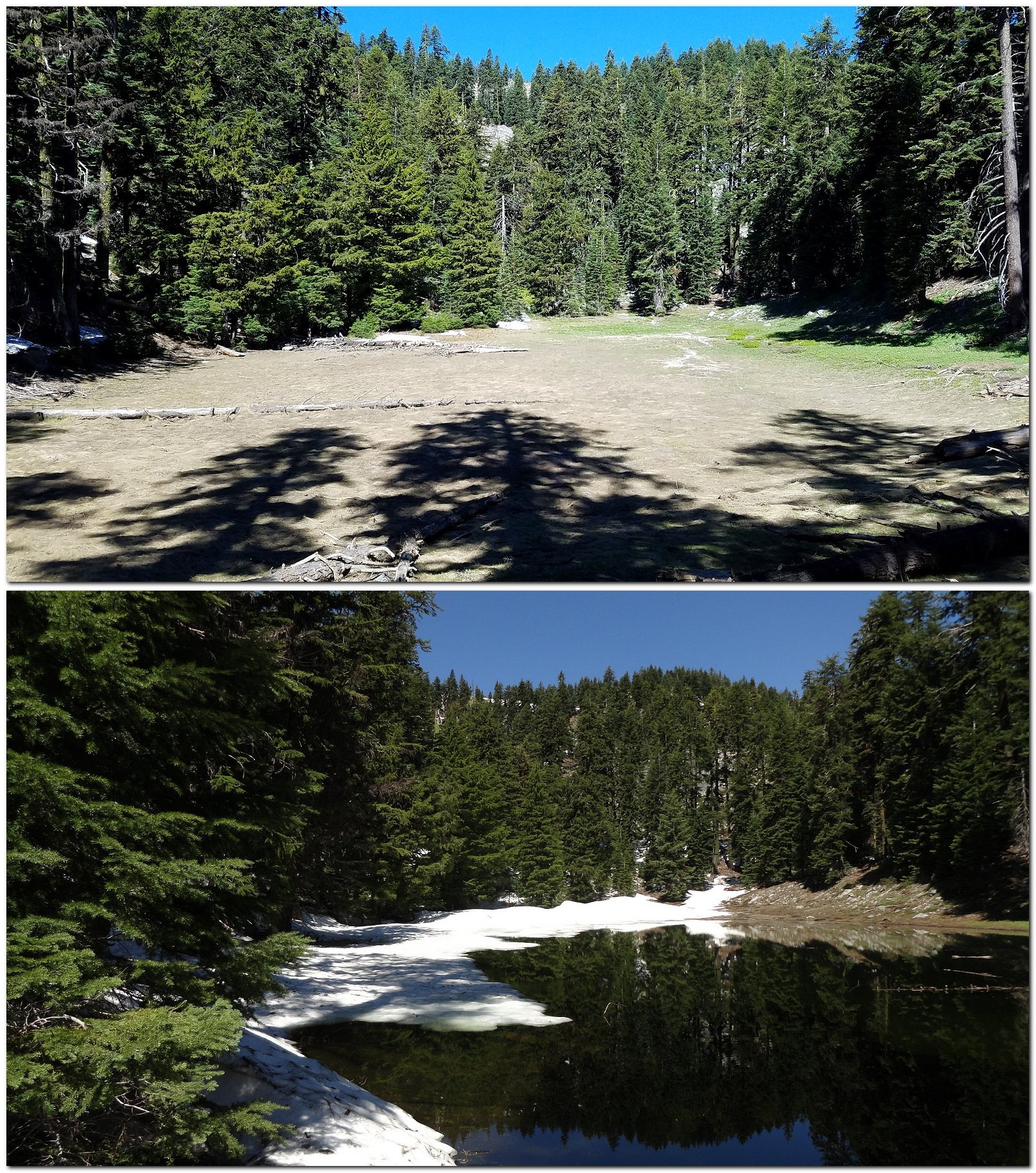
The Lake on Mt Ashland

If you know where to look, there is a small lake on southern Oregon’s Mt Ashland.

Top: the lakebed this year. Bottom: the lake full of water on July 4, 2011. The two pictures were taken from about the same place.

Let me qualify that. It’s not actually a lake, it’s more like a large vernal pool. And it isn’t directly on Mt Ashland, it’s on the west wall of Grouse Gap, the big meadow-filled basin that lies just west of Mt Ashland. Mt Ashland forms Grouse Gap’s east wall. But if you get to the right place at just the right time – most of the way, but not all of the way, through the snowmelt season – there is, in fact, a lake there.

Wednesday of this week wasn’t the right time. We were too late: the lake had come and gone, which is the way we commonly find it. We’ve been able to get there when the lake was full only once. But it’s always fun trying.

Yesterday’s hike started early, with breakfast at The Breadboard in Ashland shortly after 7:00 AM, followed by a drive up I-5 and the Mt Ashland Ski Road to Forest Road 20, which heads west from the ski area along the crest of the Siskious, a high landscape of rocky peaks, lingering snow, and wildflower meadows – but very few lakes – to Dutchman’s Peak. By 10:00, following a couple of stops and some really slow driving along heavily-potholed Road 20, we were ready to walk.

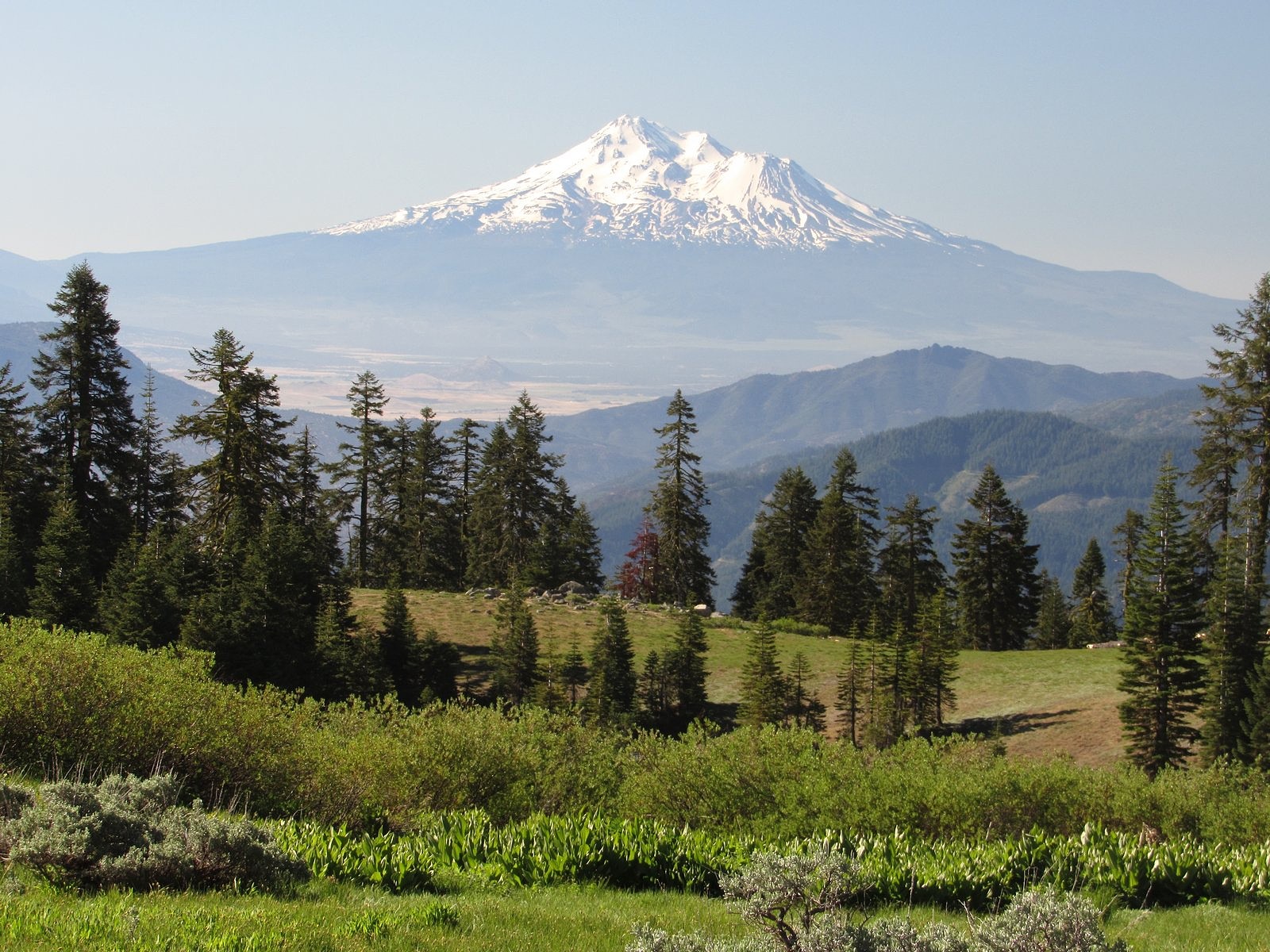
Mt Shasta from Grouse Gap.

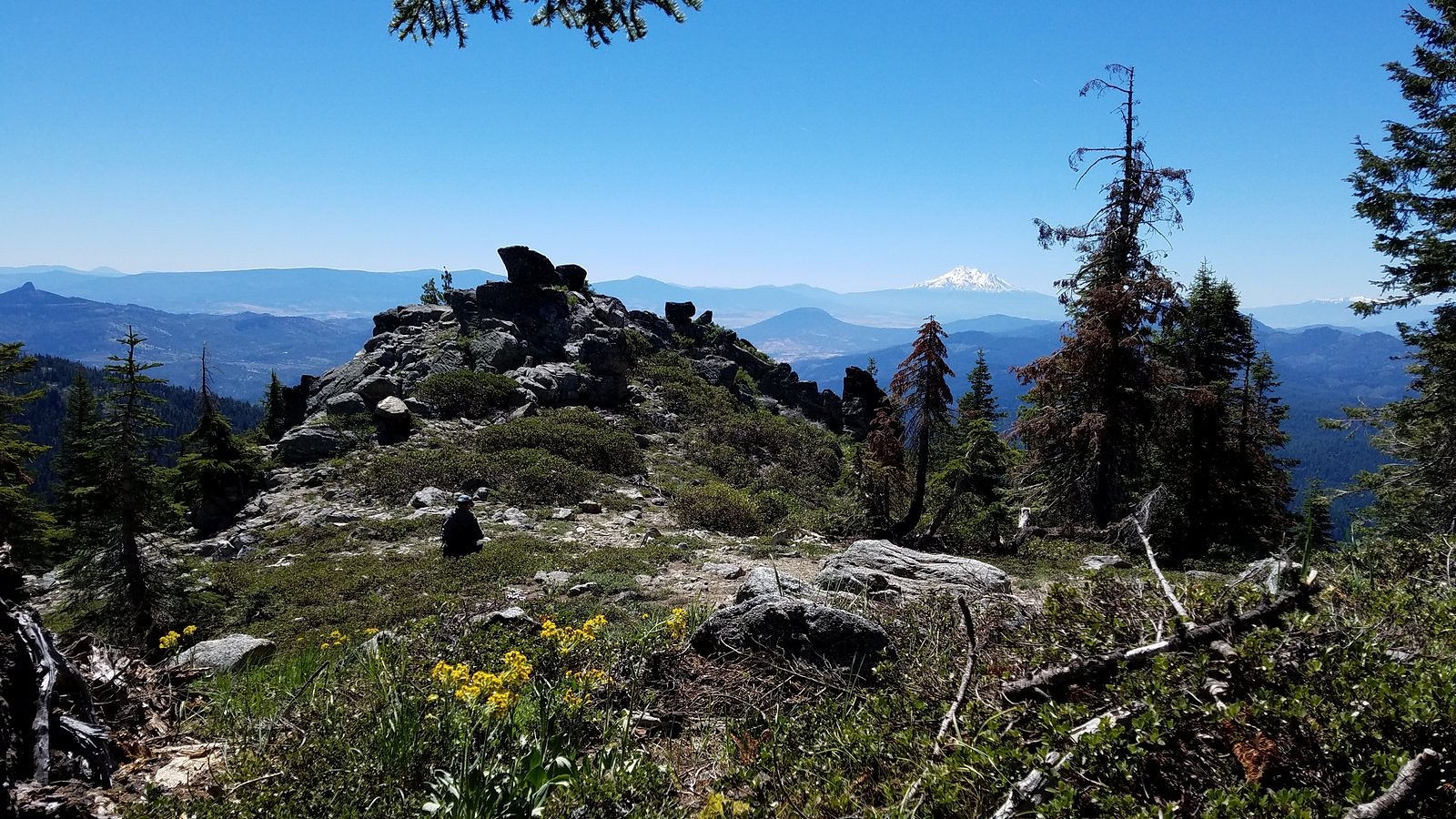
We began on the Pacific Crest Trail, heading west from the Grouse Gap trailhead through meadows and woods to the rocky opening, near the big switchback on the gap’s west wall, where we knew we could see the lake if it was there. It wasn’t, but we decided to go down to look at the lake bed anyway. From the dry lake, we worked our way cross-country to the real goal of the day – a large rock outcrop on the west ridge of the gap we’d been to once before. The combination of rock scrambling, flowers, dramatic dropoffs, and huge views dominated by the double white cone of Mt Shasta make it one of my favorite spots in the Siskiyou range.

Flower photos and granola bars dominated the next hour.

The outcrop, with Melody seated at its base.
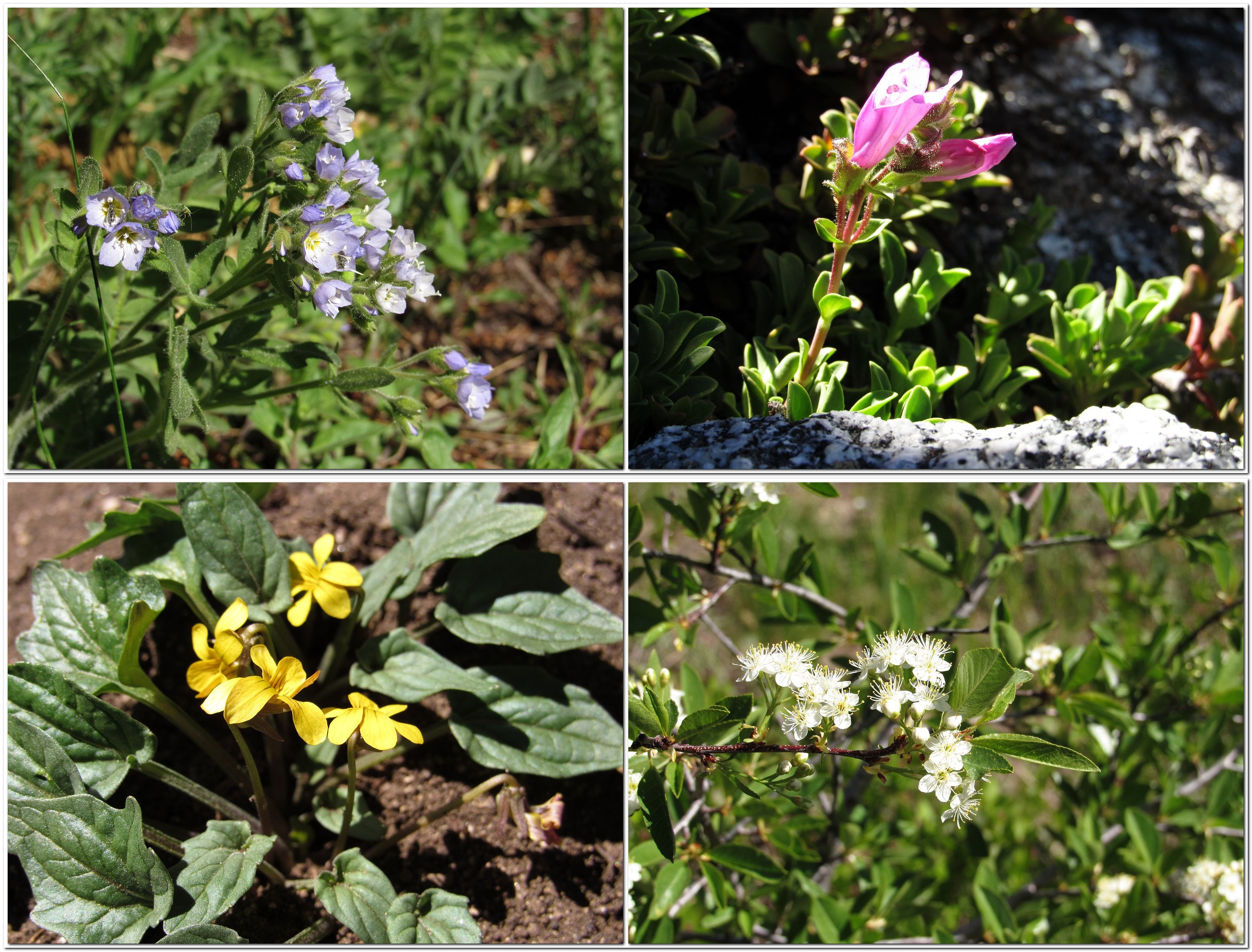
Clockwise from upper left: showy polemonium, cliff penstemon, bitter cherry, Nuttall’s violet.

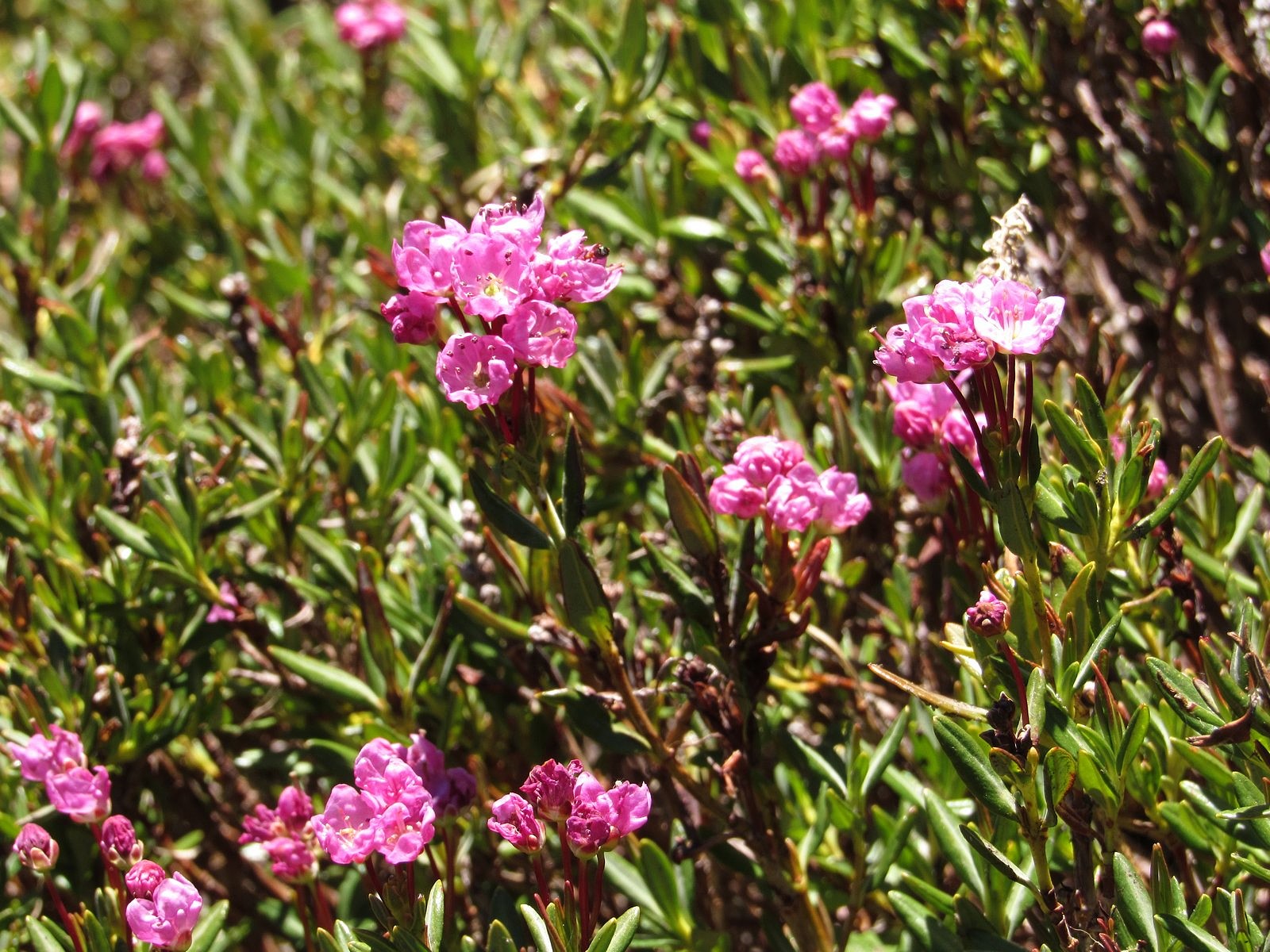
We kept to the ridge on the way back, climbing up and over the unnamed rock knob at its crest and coming down to the high saddle that’s converged on by both the PCT and Road 20 to cross the ridge – the trail and the road are perhaps fifteen feet apart at that point, so you have a choice. We chose to walk the road for a bit. There’s a spring full of buttercups, on a steep, open hillside of small streams lined with kalmia, in the bend where the side ridge we’d been on joins the main east/west backbone of the range, and we often use that hillside to drop from the road to the trail, some distance below. A deep draught of the good juice of the Earth from the spring, a visit to the kalmia – the blooms were fading but still lovely – and we were soon back to the car, ready to head down the mountain and rejoin the rest of the human race.

Kalmia

This is an electric-car blog, so I’ll put in a word here about the great advantage of an electric car over an ICE – internal combustion engine car – for mountain driving. It is 36 miles from our home to the Grouse Gap trailhead, with a 5600-foot elevation gain, most of it in the 20 miles between the Highway 66 freeway interchange in Ashland and the trailhead. Climbing those 5600 feet requires extra energy, in either an electric car or an ICE. What’s different about electric drive is that, on the descent, you gain a fair amount of that extra energy back. An ICE will just burn more gasoline – if only enough to keep the engine turning over and available.

The screen that reports a running total of the number of kilowatt-hours drained from the Bolt’s battery pack since its last complete charge holds the key figure, here. That screen read 16.1 kwh at the trailhead. It read 13.2 kwh at the Highway 66 interchange, meaning that almost three of those depleted kwh had been put back in – the car had only borrowed them. By the time we pulled into our garage, sixteen miles further along, we had used up those three regenerated kwh plus one more – the screen reading was 17.2. We’d used a net of just over one kwh to travel 36 miles. That’s the equivalent, roughly, of 750 mpg in an ICE, on cheaper fuel. Add the Bolt’s rough-road cred – full torque available at all speeds; clutchless application of that torque (allowing finer control for dealing with potholes, puddles, and rocks); and seven inches of ground clearance (two inches more than a typical sedan, and only a little over an inch and a half less than a Subaru Outback), and I can’t for the life of me figure out why anyone would want to drive anything else.

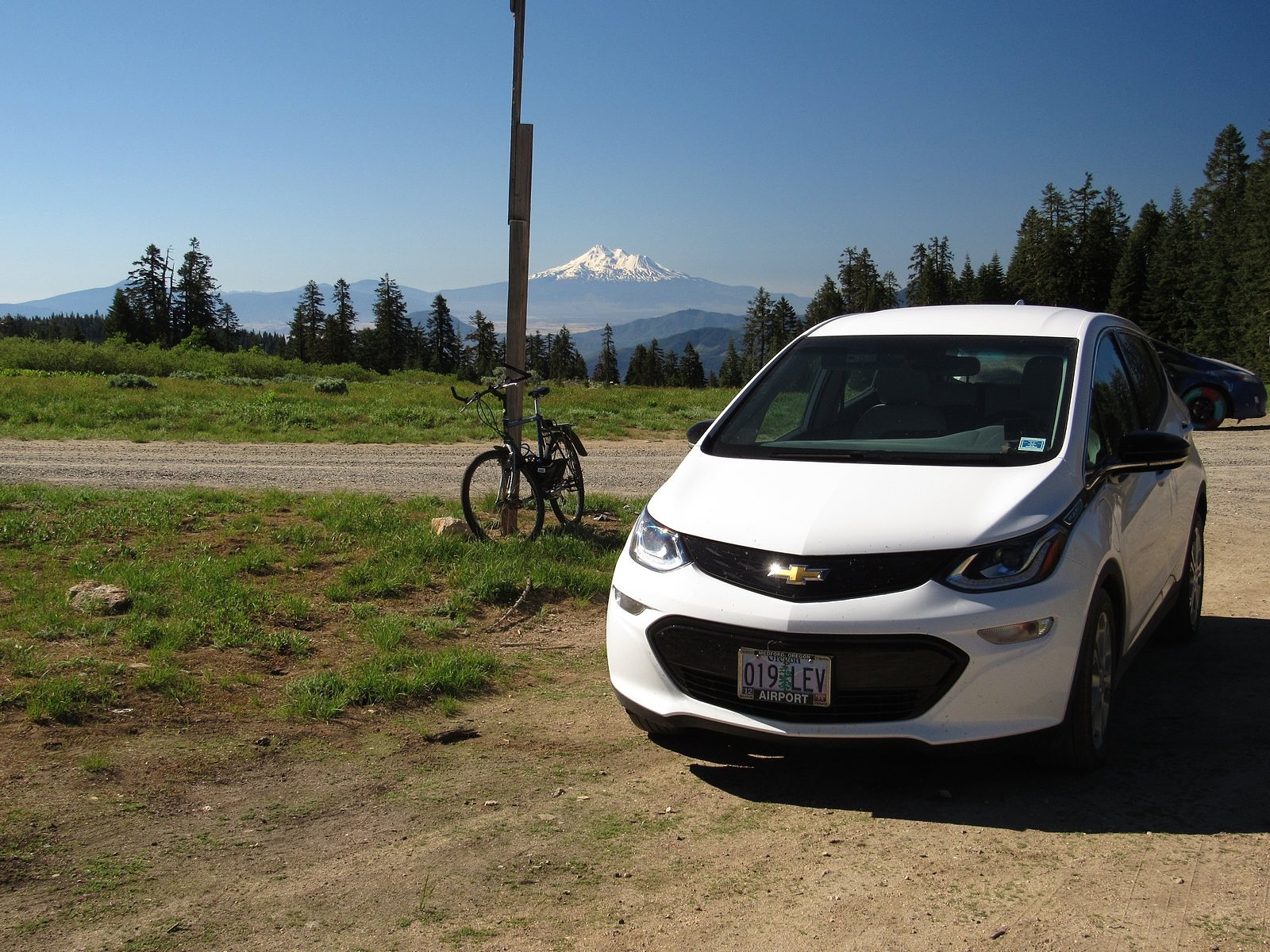
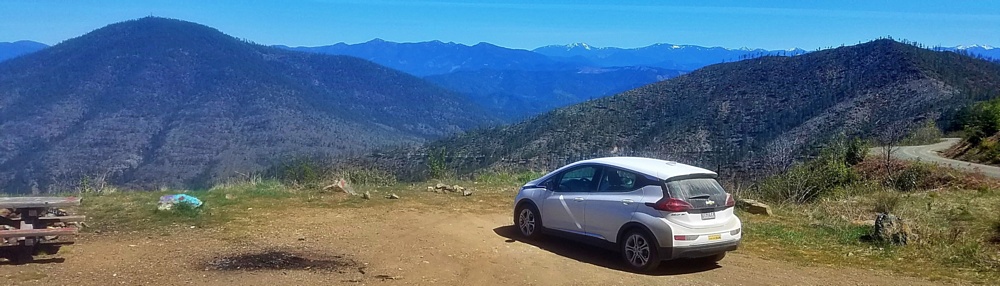
The Bolt at the Grouse Gap trailhead, with Mt Shasta in the background. Lead photo: Mt Shasta over meadow larkspur in Grouse Gap.

Mount Ashland in mid-May, 2019: a few flowers, and a whole lot of snow!

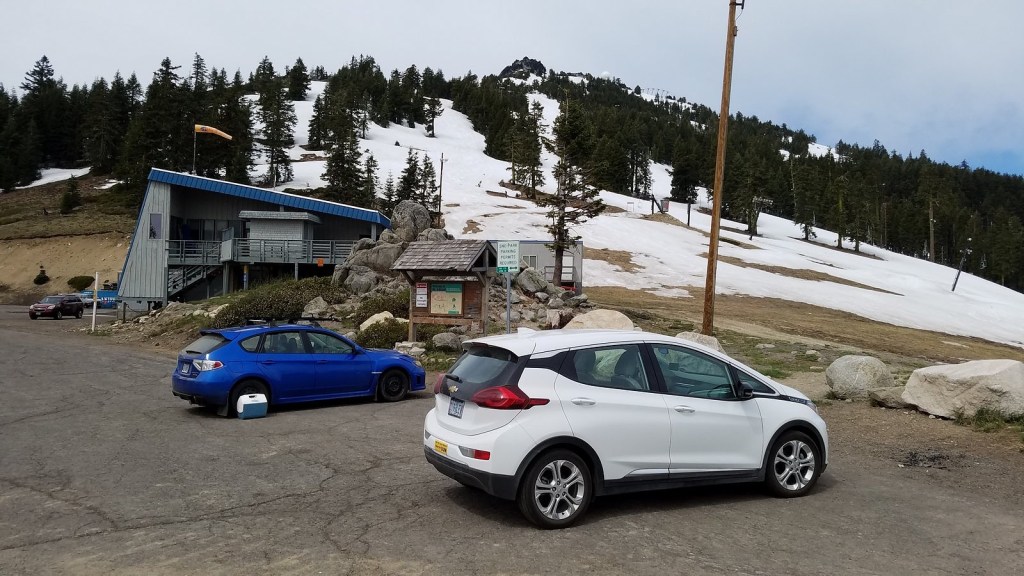
The Bolt in the parking lot for the Mt Ashland ski lodge – not the place we left it during the hike.

Melody and I spent most of yesterday on Mt Ashland, checking out current snow and wildflower conditions. We found a lot of the former and not very many of the latter; here are a few of the more than 100 pictures I shot.

The walk

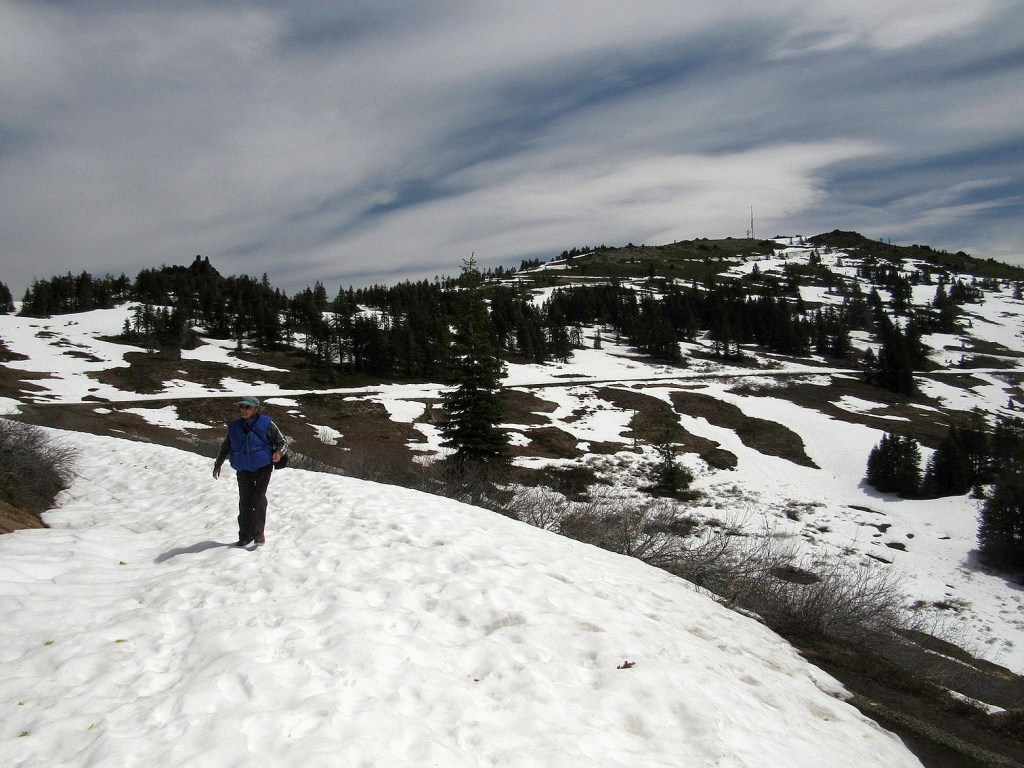
The gate was closed on Road 20 at the west end of the Mt Ashland Ski Area, so we parked a couple of hundred feet east of it, in a spot I judged would have shade when we got back to the car, and walked the road toward Grouse Gap. The road was plowed to the branch that goes to the summit of the mountain, and then up that branch; that’s for the people who service the equipment on top of the mountain, including a TV broadcast antenna and a weather radar dome as well as the upper terminals of a couple of ski lifts. At the junction, we chose to stay on Road 20. After the plowed part, the road was three to six feet deep in snow. Some of the time there were bare patches along the edges, and we could walk in those; at other times, there was no choice but the top of the snow, which luckily was fairly firm. Grouse Gap itself was covered with snow to a depth of about two feet. Weather was cloudy and cold when we started walking around 10:30, but had mostly cleared by the time we got back to the car five hours later, having walked a total of about 5 miles. The Bolt was in the ONLY small bit of shade in the very large parking lot, and yes, I felt smug.

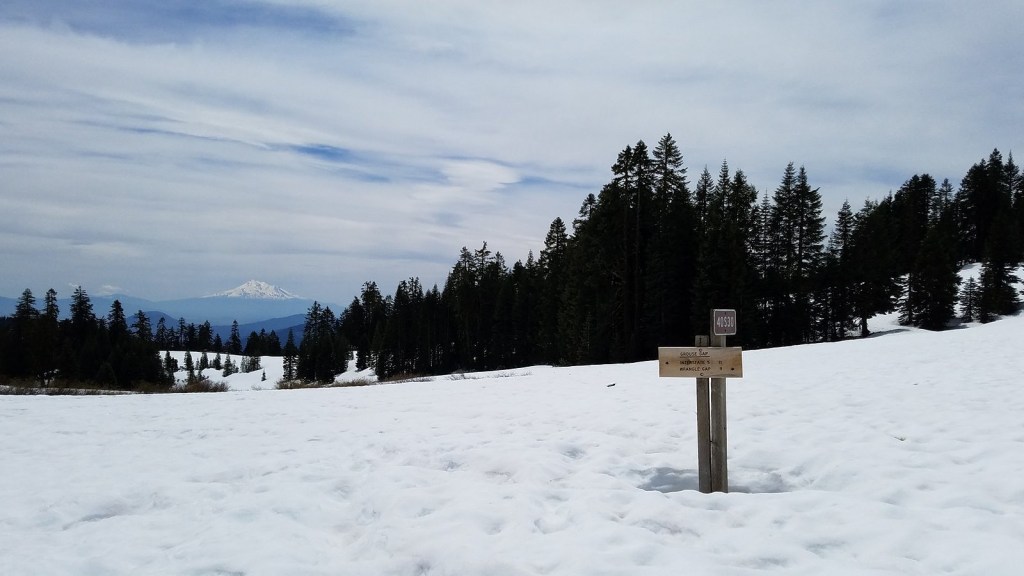
Grouse Gap. Mt Shasta in the distance.

The flowers

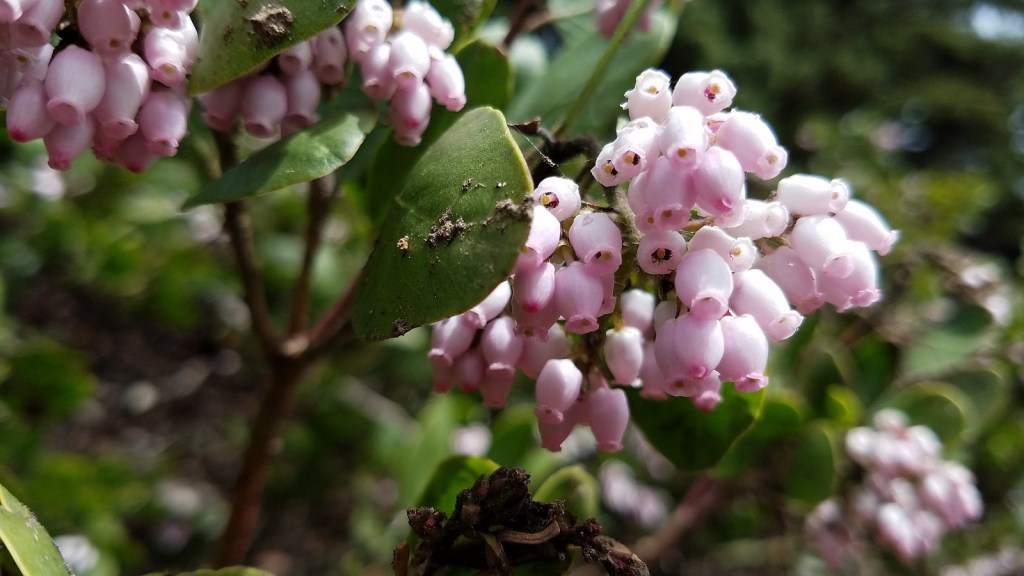
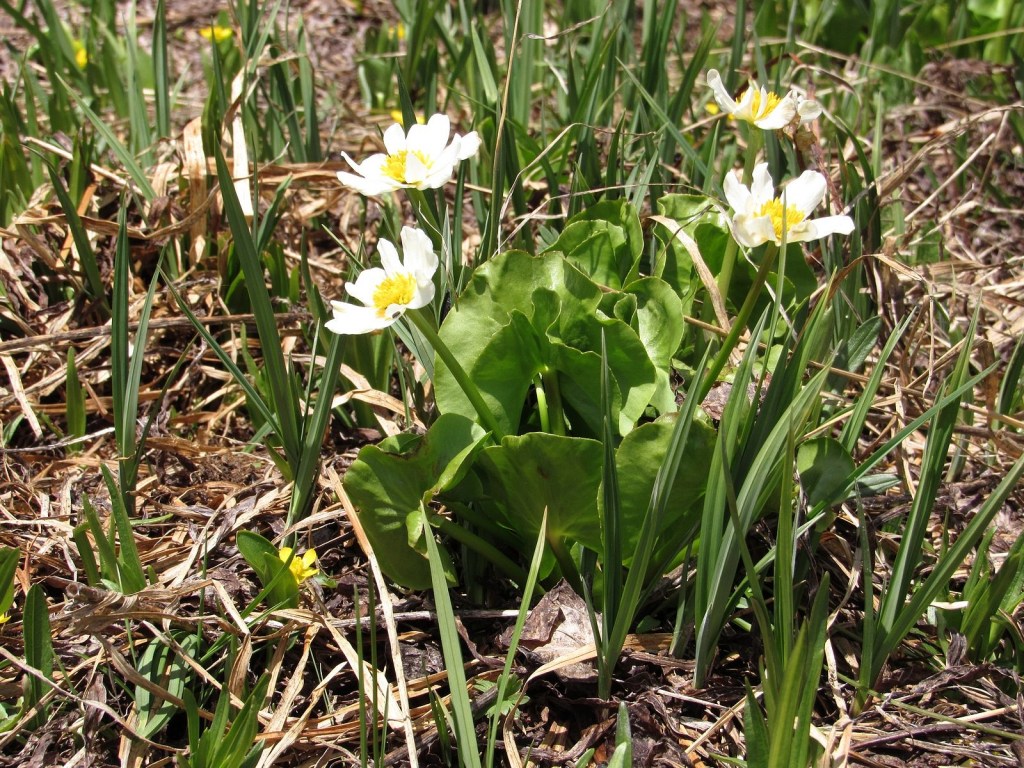
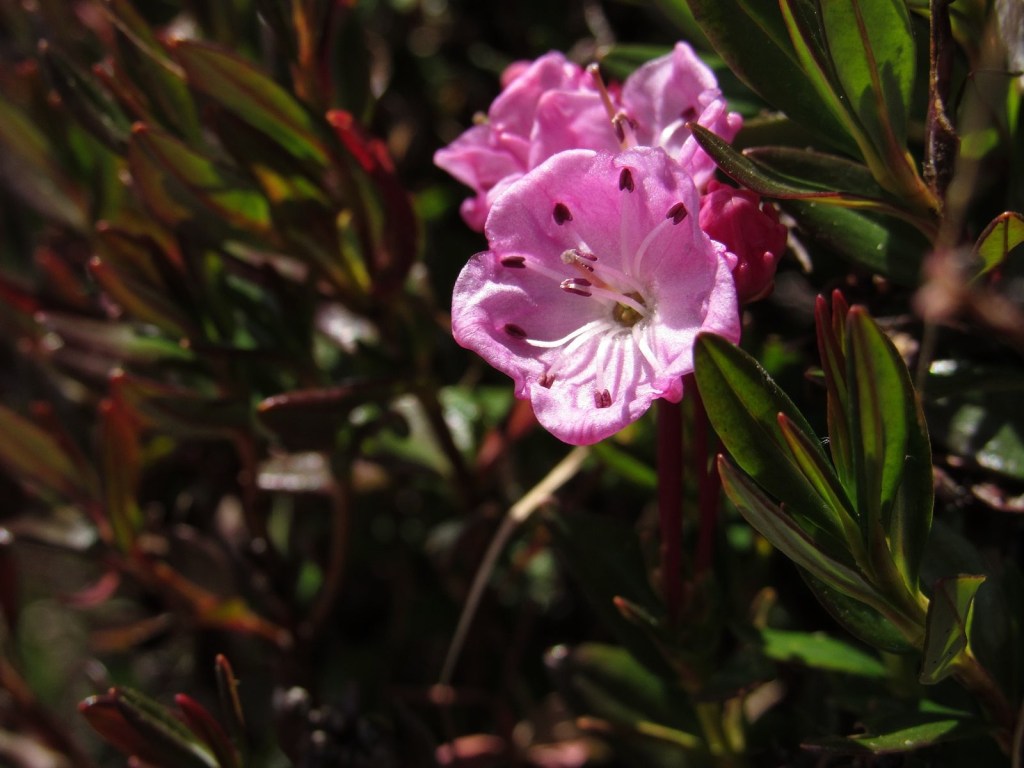
Walking in, the only things we saw in bloom were manzanita bushes, but I did spot some color in a large bare area up a south-facing slope above the road near the big bend in the road beneath the rock formation known as the Rabbit Ears, so we climbed the slope to investigate on the way back. The “color” was a large patch of mixed buttercups and marsh marigolds. They were accompanied by a few miniature white lomatiums, and not much else – except a tiny patch of kalmia, with two fully-developed blooms. We hadn’t seen kalmia on that part of the mountain before, so finding it was the highlight of the day.

Kalmia microphylla, western bog laurel.

The car

The Bolt, of course, behaved splendidly. Interesting point: it’s 35 miles from our house to the ski area parking lot, during which one climbs a bit over a vertical mile. The gauge that measures the car’s electrical use read 15.6 kilowatt-hours (kwh) when I turned off the power in the parking lot. It read 15.7 kwh when I turned off power at home, at the end of the trip. The power generated by the drop in elevation had almost matched the power used by the 35 miles of distance, and we had used just a net 0.1 kwh on the return trip. The estimated remaining range had actually increased by 47 miles, from 150 in the parking lot to 197 at home. Try to do THAT in a gasoline-powered car.