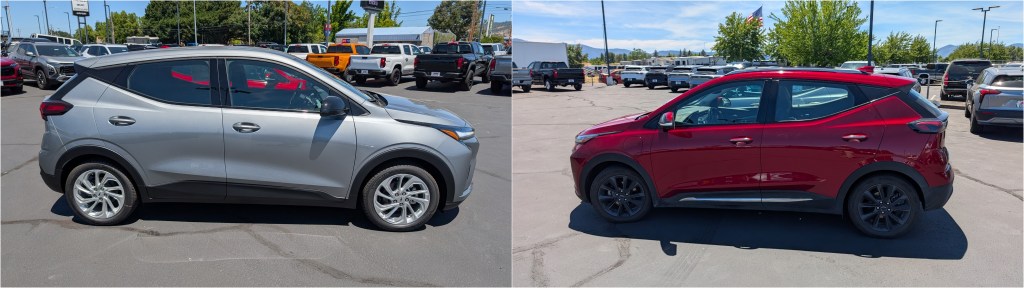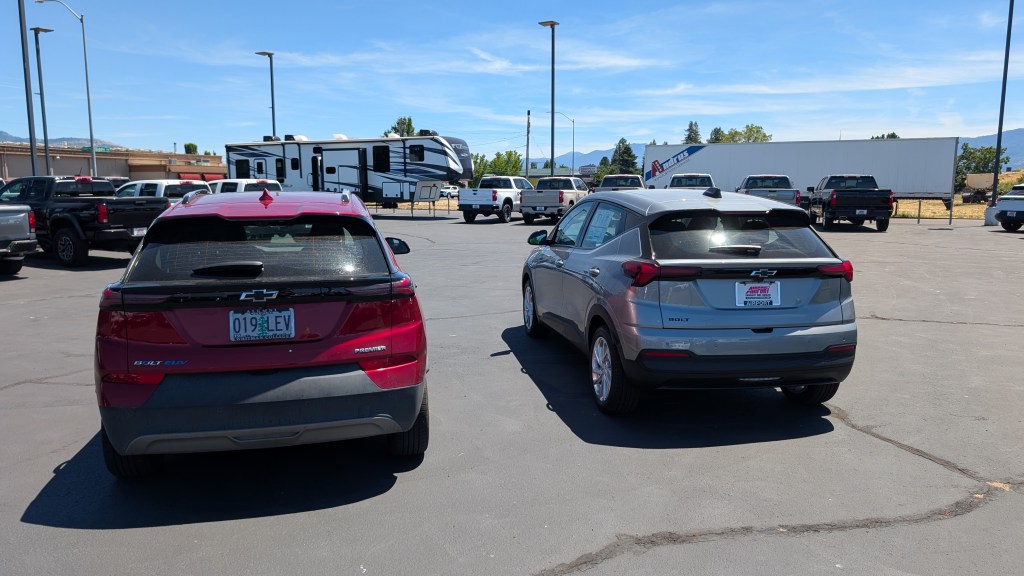
As the owner of both first- and second-generation Bolts (successively, not simultaneously), I have naturally been curious about the third generation – the car that went on sale, as a 2027 model, in late January of this year. How is the new car different from its predecessors? Are the differences improvements? There was only one way to find out: so a few days ago I went down to Airport Chevrolet, here in Medford, Oregon, to take a look. Here’s what I found.
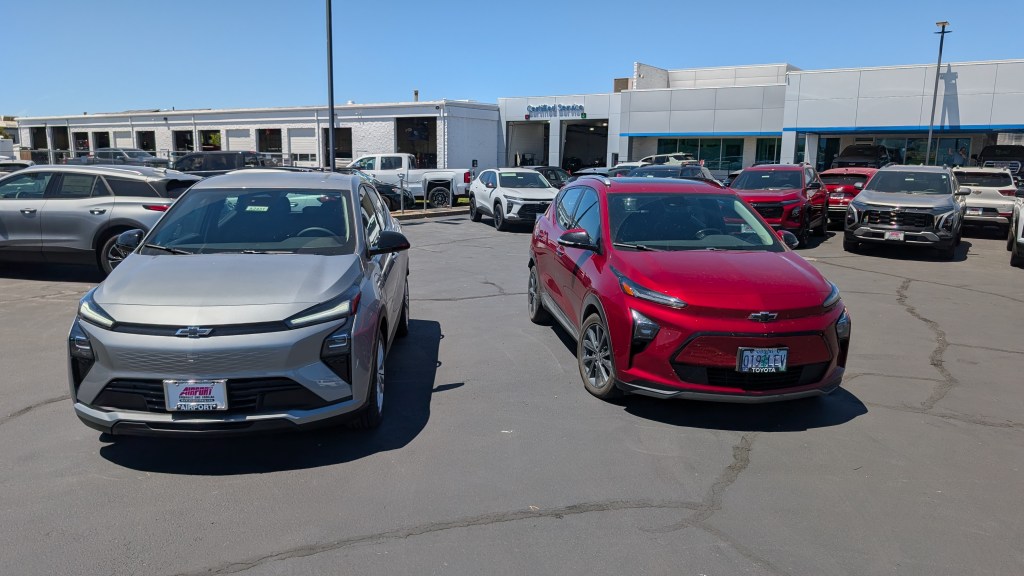
(A caveat: this was a very quick look. I didn’t drive the car, and I didn’t go into great detail with Drew, the sales rep who was kind enough to show the car to me even after I made it clear that I was there to write about it, not to buy it. I did sit in it (front, back, and driver’s seats), and I played with the infotainment screens a little, and I was able to compare the new version side-by-side with my 2022 Bolt EUV (see the picture, above). And I got Drew’s views, as an EV driver himself – his personal car is the Bolt’s big brother, the Equinox EV – on some of the new gimmicks GM has added to its EV line. I’ll pass an opinion or two of his on to you, along with my own.
About that self-contradictory headline: here’s the thing. What GM gets right is just about everything about the vehicle itself. I have a few minor qualms (you’ll hear about them shortly), but overall, it’s a home run. It preserves everything I’ve liked about the first- and second-gen Bolts, while strengthening many of the earlier cars’ weak points, and it does this while perfectly maintaining the original Bolt’s slightly offbeat ambience – not a easy thing to do after a several-year gap in the model line. What GM still doesn’t get right, though, is its long-term plan for the car. You’d think, after all of the outcries that followed their cancellation of the original, that they would let this one stick around for a good long time. No such luck. The Bolt is back, but only for a limited run. They will be building them for just 18 months: after that, the plan is to shut down the factory and convert it back to – you guessed it – gasoline vehicle production.
Really, General Motors? Do you really think that demand for an excellent, low-priced, much-loved EV like this, with a popular cachet similar to that of the original VW Bug, is going to go away? What, exactly, have you been smoking?
And now, with that out of the way, let’s talk about the car.
First impressions: this is definitely a Bolt. Detail differences in the front and rear facades aside, it is essentially identical in appearance, inside and out, to the 2022-23 EUVs, and until you learn to look for those little details – things like the slightly reshaped taillights and the thin black line that now connects the running lights across the face of the car – you probably won’t be able to tell them apart. The luggage compartment and back seat are both indistinguishable from my EUV’s. Chevy wisely avoided saddling the new Bolt with the bizarre pop-up door handles they put on the Equinox EV, which remind this old-timer far too much of the highly similar – and blessedly failed – door handles found on the 1955 DeSoto. My worry that they might do this, thankfully, was unnecessary: the new Bolt’s doors open with the same push-button door handles that the old ones’ do.
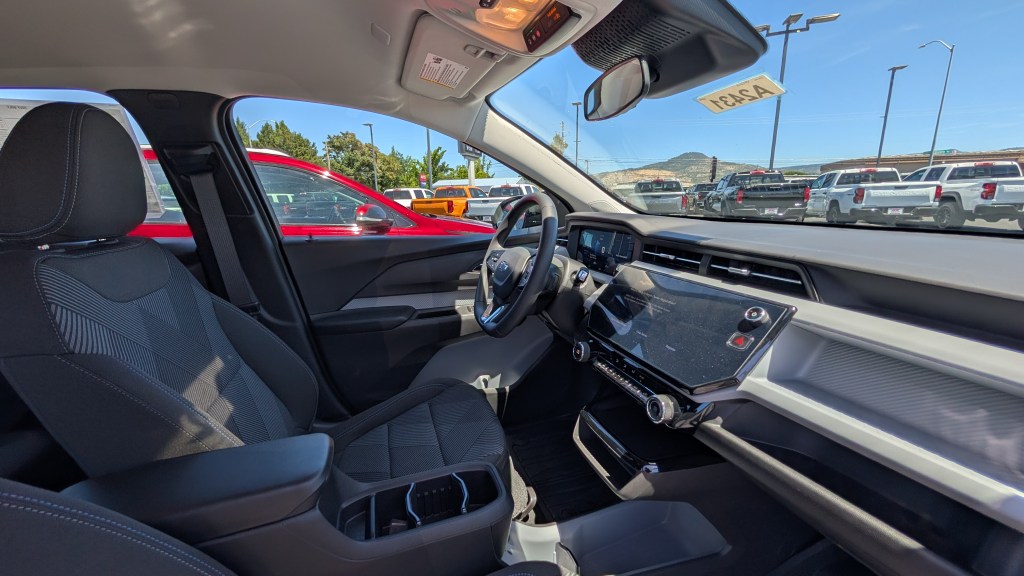
Things I like: improved visibility for the rear turn signals (they’re now included in the redesigned taillight nacelles, instead of lurking down near the bumper where a car close behind you at a traffic light can easily miss them). A really generous set of storage cubbies in the front cabin, compared with the paucity of small-item storage found (or not found) in the older Bolts. The improved dashboard instrumentation/infotainment system, which clusters more information directly in front of the driver, and makes the rest easily available on the significantly larger – and more user-friendly – center screen. Dumping the proprietary navigation system in favor of a built-in version of Google Maps, meaning that the maps are always up to date, and that they include important things like the hours of stores and restaurants and the current availability of nearby sets of chargers.
Things I don’t like: the climate controls, which are slightly improved over those in my EUV (you no longer have to use the touch screen to change the direction of the airflow) but still can’t match the ones found in the Gen 1 Bolt, which I thought were models of clarity and simplicity. The absence (still!) of a frunk. The gear selector – oh, yes, the gear selector. It is now mounted on the right side of the steering column, where the wiper controls used to be. The wiper controls are now relegated to the left side of the column, where they have been combined with the turn signals into a truly Rube-Goldbergian design that I’m sure my mother would have referred to as a “fearful and wonderful contraption.” They say it was done that way to add extra storage room in the center console, but I dunno. To me, it smacks of change for change’s sake. I’ve seen this movie before.
I’m going to digress a bit here to explain that last sentence. The first car I can remember from my childhood was my father’s 1935 Ford two-door sedan, with bucket seats and a gearshift sticking up out of the drivetrain tunnel between the driver and the passenger. That was the standard design when Dad’s Ford was built. By the time he purchased his next car – a 1947 Pontiac – the designers had become bored with that: gearshifts in almost all American cars had been moved to the steering column, the bucket seats had been replaced by a bench, and that had become the standard design. A decade later, apparently bored again, auto companies had begun experimenting with other possibilities. I took my high school driver training courses in a 1958 Plymouth with a push-button gear selector, not unlike the one I’ve been forced to accomodate to in my EUV. As with the current fling with buttons, those went away quickly, and the gear selector moved back to the drivetrain tunnel between two bucket seats, where it once again became the standard design – completing the circle. I think we’re just watching that same circle start up all over again, just in a slightly different order. Drew stated, when I brought this up, that he really liked the very similar shift lever in his Equinox EV; he quickly got used to it, he said, and to the fearful and wonderful contraption on the other side of the steering wheel. OK. Drew is young. I highly suspect, if civilization survives long enough to allow him to reach my age – a few weeks shy of 84 – that he will have watched the whole cycle run through at least one more time. I think it’s the Book of Ecclesiastes which points out that there is really nothing new under the Sun.
OK: back to the good stuff. I need to say a few words about the 2027 Bolt’s one really major technical upgrade – its new battery chemistry and onboard charging system. Gen 1 and Gen 2 Bolts used lithium-ion (Li-ion) batteries: Gen 3 uses lithium iron phosphate (LFP), which results in batteries that are safer, contain far fewer toxic materials, and are able to be charged all the way to 100% regularly without degrading. On a kwh-to-kwh basis, LFP batteries weigh more; but they are also more efficient. The practical upshot of this is that, although it is heavier, the new Bolt’s range is slightly greater than my EUV’s (EPA 262 miles to EPA 247) – and that its entire range can be utilized on road trips, resulting in fewer stops for charging. (It’s recommended that Li-ion batteries only charge to 80% on Level 3 chargers – the “quick chargers” EV drivers use to refuel on the road).
Charging the new Bolt is also quicker. Gen 1 and gen 2 Bolts are limited to a quick-charger flow rate of 55 kw. Gen 3 owners can quick-charge at up to 150 kw, cutting the hour of charging time my car often requires on the road to about 25 minutes, a distinct advantage. I guess. I’m not completely sold. My current practice is to drive a couple of hours, plug into a quick charger, slip into a nearby restaurant or coffee shop – chargers are almost always adjacent to restaurants and/or coffee shops – and have a nice leisurely cup of coffee or, at appropriate times, lunch or supper. I consider these relaxed stops one of the pleasures of EV touring, and I’m not sure I’d be all that happy trying to squeeze them into the new Bolt’s far more rapid charging time. You gain a little, you lose a little. Sometimes you lose a lot.
To round out the multiple changes to the battery and charging systems, the new version is equipped with a NACS (North American Charging Standard) charging port, rather than the CCS (Combined Charging System) port found on earlier Bolts – meaning that the newer car can use the widespread and highly dependable Tesla nationwide charging network without an adapter. It now requires an adapter for CCS plugs, though, or for J1772s – the standard connectors for the level 2 chargers found in home garages and, increasingly, at motels and restaurants – so they’ve really just moved the deck chairs around. As with the new car’s charging time, the gain is at least partially offset by the loss.
Bottom line: will I buy a 2027 Bolt? No. I have no urge to replace my EUV, which is – except for the instrumentation and battery/chargins system changes – almost exactly the same car. Do I recommend it to others? Definitely. These are really sweet little vehicles. They punch above their weight: they may look small from the outside, but there’s a surprising amount of room inside, and they drive like a much larger, pricier car. When I am asked to sum up my EUV’s appeal in one word, that word is always competent. If I ask it to do something, it does it. No flash, no drama: just solid, matter-of-fact, dependably spot-on performance, every time. If that sounds boring, you probably don’t want this car. If it doesn’t – if competence, refined driving feel, ridiculously low fuel costs, and a touch of luxury (at least in the higher trim lines) sounds enticing – then you might consider picking one of these small jewels up. Quickly, before GM cancels production again.